Exclusive | Hoverboard makers form guild to help them back to the future
China’s industry of hoverboard producers has slumped in the two years since Amazon pulled them from stores over fire concerns, with the number of makers shrinking by 75 per cent.

Chinese manufacturers of hoverboards are establishing an association to rescue their industry, with a set of guidelines for raising technical standards and specifications to enhance quality, seeking to regain customer confidence after Amazon.com pulled them from sales in December 2015.
Amazon removed hoverboards from its online store after customers complained of them catching fire during charging. The global industry had fallen into a slump ever since, with the price of boards plunging by 75 per cent, while smaller makers were forced out of the market in China. The entire industry halved in value in two years.
“We have united with lots of major companies in the industry to raise the industry standard to rescue the industry,’’ said Ying Jiawei, president of Hangzhou Chic Intelligent Technology, during a Tuesday meeting of manufacturers in Hangzhou. “How much the industry will recover rests on customers’ confidence.”
China dominates the world market of hoverboards, a two-wheeled substitute of ambulation once hailed as the future of mobility, where 80 per cent of production are for exports.
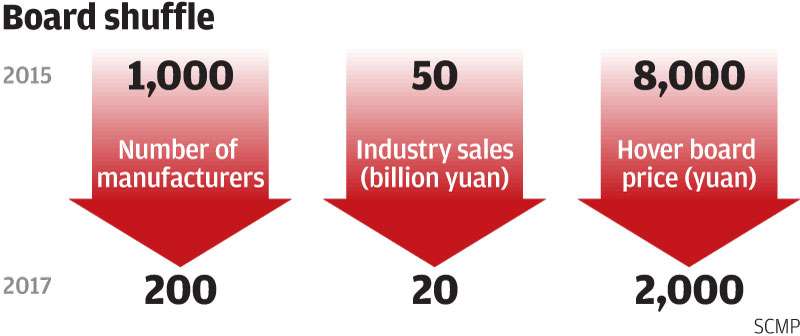
The industry is already experiencing a consolidation. There are about 200 manufactures now from the peak of more than 1,000 amid decreasing sales, according to Ying. The value of the industry plunged to 20 billion yuan, from a peak of 50 billion yuan (US$7.3 billion) in 2015.