Advertisement
Advertisement
Stocks
Get more with myNEWS
A personalised news feed of stories that matter to you
Learn more
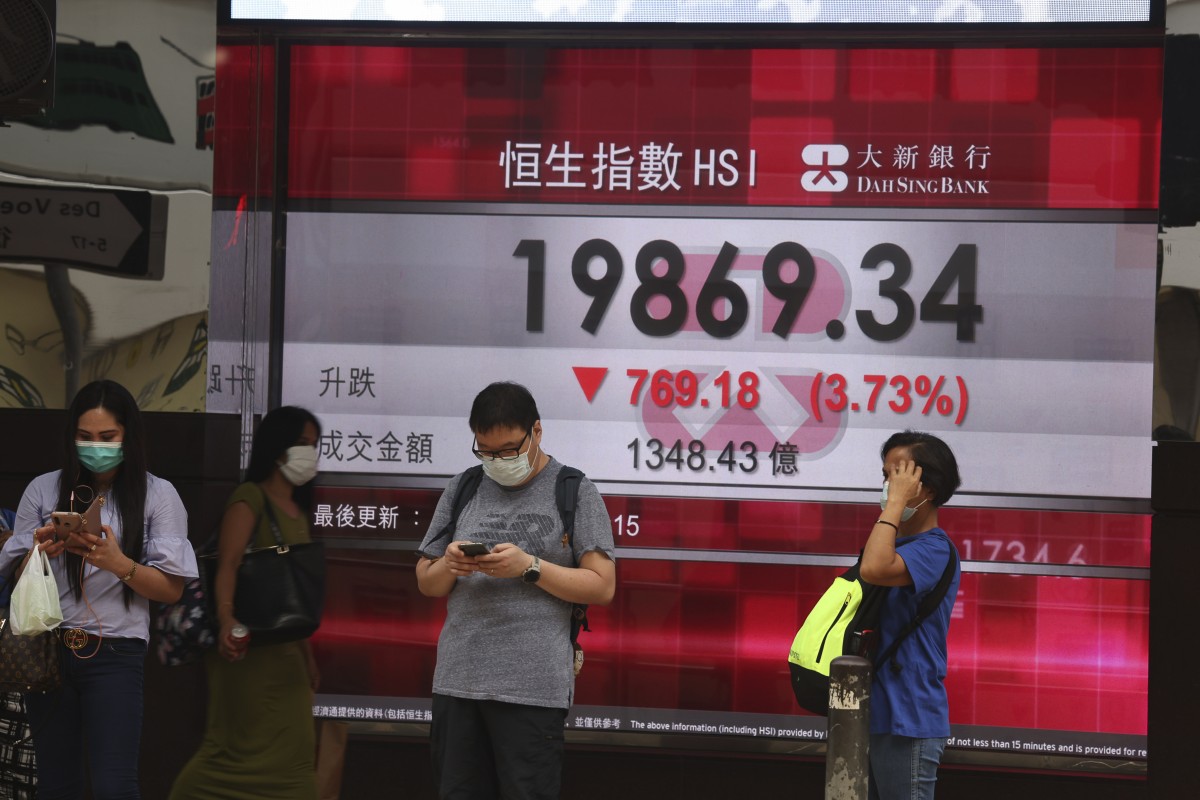
People passing by a screen showing the Hang Seng Index in Central, Hong Kong on April 15. Photo: K. Y. Cheng

Alibaba, JD.com lead tech rout in Hong Kong on inflation jitters while China hardens zero-Covid stance

  • The Hang Seng Index slid 3.8 per cent at the close of Friday trading, while the Tech Index tumbled 5.2 per cent in the biggest sell-off in four weeks.
  • ‘This is a major bear market’ as the US, Europe and Chinese economies face mounting growth risks, ACY Securities says
Stocks
Hong Kong stocks slumped by the most in more than seven weeks as the threat of global inflation and speedy interest-rate increases prompted traders to dump riskier assets, with US equities suffering US$2.4 trillion rout overnight.

The Hang Seng Index slid 3.8 per cent to 20,001.96 at the close of Friday trading, the most since the March 15 crash. The Tech Index tumbled 5.2 per cent in the biggest sell-off in four weeks. The Shanghai Composite Index and Shenzhen Component Index both declined by more than 1.7 per cent amid dimming growth outlook.

Alibaba Group Holding, the owner of this newspaper, slumped by 6.6 per cent to HK$90.35. Meituan sank 4.7 per cent to HK$157 and Tencent retreated 4.7 per cent to HK$349.20. JD.com plunged 6.2 per cent to HK$226.60. Country Garden lost 9.5 per cent to HK$4.86, leading a broader 3.6 per cent slide in the Hang Seng Properties Index.

Today’s slide extended the losses in the Hang Seng Index to 14 per cent this year, wiping out more than US$327 billion of market value. Another US$3 trillion has been erased from the Shanghai and Shenzhen bourses through May 5, amid mounting economic toll from lockdowns under China’s zero-Covid policy.

“This is a major bear market,” said Clifford Bennett, chief economist at ACY Securities in Sydney. “The US economy is in diabolical shape, Europe is at war. And Shanghai, the world’s biggest port, is in extended lockdown. This is truly catastrophic.”

The S&P 500 Index sank 3.6 per cent to erase US$1.3 trillion of market value. It was only the fifth time the market has sold off more than 3.5 per cent since the depth of the Covid-19 pandemic in March 2020, according to Bloomberg data. The Nasdaq Composite Index plunged 5 per cent, lopping US$1.1 trillion of value.

03:02

Shanghai residents under Covid lockdown protest against lack of food

Shanghai residents under Covid lockdown protest against lack of food
China on Thursday reaffirmed its stance on zero-Covid policy, saying it will stand the test of time. President Xi Jinping has pledged to fight any attempt to “distort, question and challenge” its policies, even as reports this week showed a slide in Chinese manufacturing and services indicators amid Covid-19 lockdowns.
In Shanghai, anti-pandemic curbs remain intact as the commercial hub reported 4,269 new cases in the preceding 24 hours, officials said on Friday, delaying a resumption in production activity and clouding corporate earnings outlook.

The Hang Seng Index’s 5.2 per cent loss for the week is the most since the March 11 week. The rout reflects underlying jitters as stocks showed wild swings. Investors cheered the Federal Reserve’s 50-basis point hike on Wednesday, the most aggressive since 2000, only to head for the exit in the next 24 hours.

The Hong Kong Monetary Authority also raised its base rate by the same quantum in lockstep to 1.25 per cent, with policymakers cautioning consumers about the cost of borrowing on mortgages. The local economy faces recession risks after contracting deeper than expected last quarter amid measures to curb the fifth wave of infections.

Global growth stocks face “earnings downgrades”, Minsheng Securities said in a report on Friday. “Inflation may enter the second stage of acceleration and China’s domestic inflation may be ignited at any time,” it added.

Bestlink Technologies, an information and communication technology service provider based in Nanjing in the eastern Jiangsu province, surged 44 per cent to 20.92 yuan in its Shenzhen trading debut.

Elsewhere in Friday trading, South Korean and Australian stocks retreated 1.2 per cent and 2.2 per cent, respectively, while Japanese equities gained 0.7 per cent.

2