Advertisement
Hong Kong stock market
BusinessMarkets

What does it take to go overweight on Chinese stocks? US$5.5 trillion of credit expansion, BCA estimates

  • Hold off from going overweight on Chinese stocks as strong January financing data obscures below-par trend against past easing cycles, BCA says
  • Stocks have weakened 0.5 to 1 per cent despite encouraging January data, underscoring caution among investors

Reading Time:3 minutes
Why you can trust SCMP
An electronic ticker displays stock figures in Pudong’s Lujiazui Financial District in Shanghai on February 7  2022. Photo: Bloomberg
Cheryl Heng
China will require no less than 35 trillion yuan (US$5.5 trillion) in credit expansion to steady the economy and stem an earnings recession, and stock investors should not be swayed by January’s seasonally-strong financing data, according to BCA Research.

The sum would be needed to revive sagging domestic demand and anything short of that target would mean investors should bide their time in upgrading the market to overweight within a global portfolio, strategist Sima Jing said in a report on February 16.
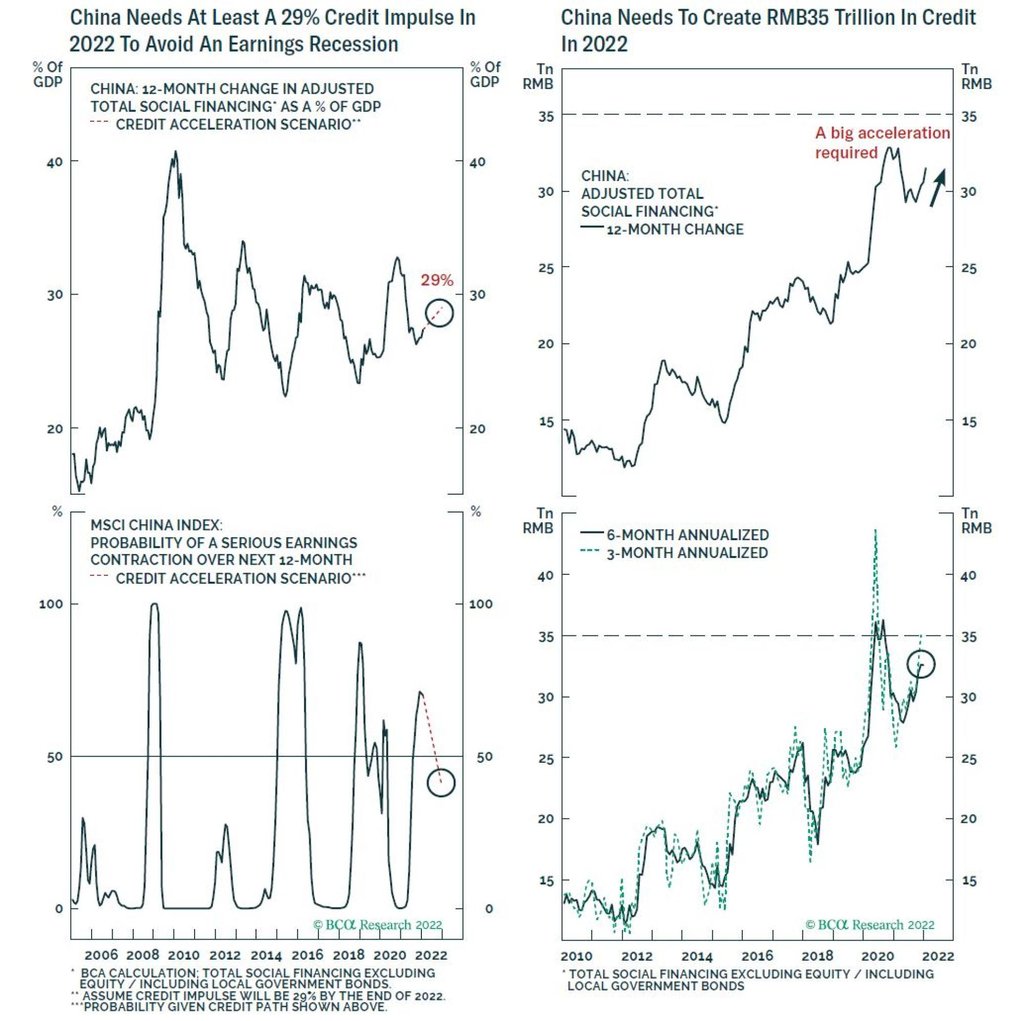
“Our calculation suggests that a minimum of approximately 35 trillion yuan of new credit, or a credit impulse that accounts for 29 per cent of this year’s nominal gross domestic product, will be needed to stabilise the economy,’’ she said. The jump in credit creation in January was “less than meets the eye, compared with previous easing cycles and adjusted for seasonality,” she added.
China credit fiscal impulse
Investors remain guarded, judging by the returns on the CSI 300 and CSI 500 Index that track the biggest stocks in Shanghai and Shenzhen. The gauges have weakened by 0.5 to 1 per cent since February 10, when China published the January credit data. The CSI 300 gauge slipped into bear territory last month, having lost at least 20 per cent from the February 2021 peak.
Advertisement

BCA arrived at its 35 trillion yuan estimate based on the flow of TSF as a share of GDP. That ratio needs to hit at least 28.5 per cent to reduce the odds of a major earnings contraction to below 50 per cent. It assumes an 8 per cent growth in China’s nominal GDP in 2022.

Advertisement

Aggregate total social financing (TSF) more than doubled in January from December. Yet, the year-on-year increase was slower than the pace seen in China’s previous easing cycles, such as in 2013, 2016 and 2019, according to the Montreal-based research firm.

01:53

City of Suzhou newest front in China’s all-out battle against Omicron coronavirus variant

City of Suzhou newest front in China’s all-out battle against Omicron coronavirus variant
Advertisement
Select Voice
Choose your listening speed
Get through articles 2x faster
1.25x
250 WPM
Slow
Average
Fast
1.25x