Global luxury market – once aiming to rival Indonesia’s US$1.1 trillion economy – heads for 18 per cent drop, as coronavirus grounds Chinese travellers
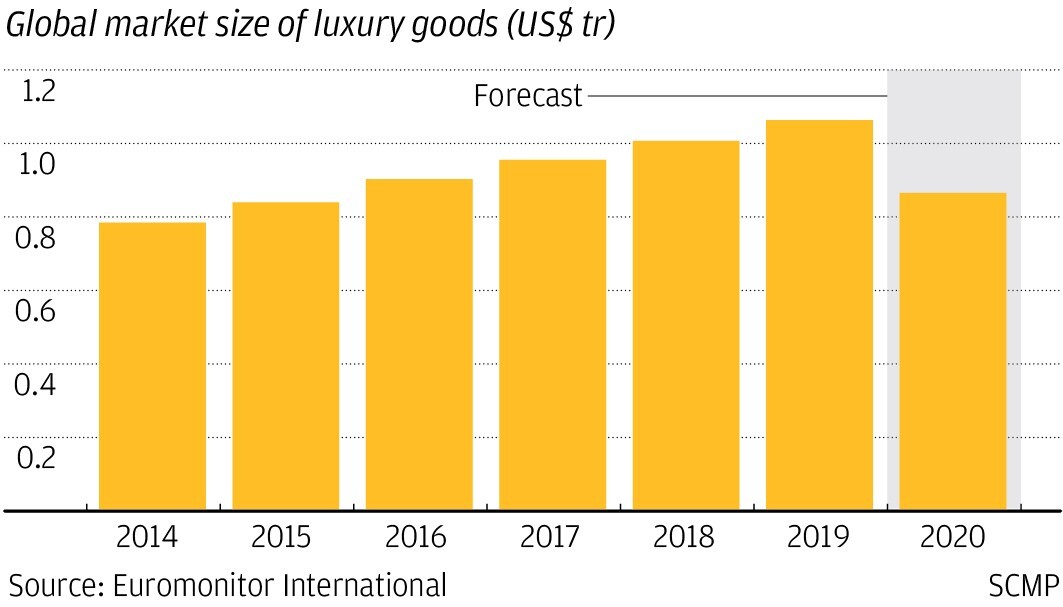
- The sector was worth US$1.06 trillion in 2019 and had been forecast to reach US$1.09 trillion this year: Euromonitor
- Asia-Pacific likely to see the most declines, as sales fall in China

The trillion-dollar global luxury market was well on its way to matching Indonesia’s economy this year, but will have to settle for an 18 per cent decline instead.
The sector, worth US$1.06 trillion in 2019 and slated to grow 3 per cent and reach US$1.09 trillion this year, will shrink to US$865 billion, a four-year low, as the coronavirus pandemic disrupts Chinese consumers’ travel plans, a direct hit on luxury goods spending, market-research company Euromonitor International said. Indonesia’s economy, the world’s 16th largest, was worth US$1.1 trillion as of October 2019, according to the International Monetary Fund (IMF).
The global luxury sector has been a trillion-dollar market since 2018, according to Euromonitor’s “Luxury and Covid-19: Effects on the Industry” report.
“Luxury shopping behaviour, channel dynamics and travel plans are seeing inevitable shifts as a result of lockdowns,” said Fflur Roberts, head of luxury goods research at Euromonitor. “With the pandemic having a huge economic and psychological impact, consumers’ sentiment will be severely dampened and premium priced items are likely to be affected.”
While the global economy as a whole is forecast to fall by 3 per cent this year, according to the IMF, it is in the Asia-Pacific region that the sector is likely to see the most declines, with sales in China falling by 22 per cent – a US$68 billion loss, according to Euromonitor. In 2019, the region generated luxury goods sales worth US$438 billion, the largest number globally. Chinese consumers accounted for 68 per cent of these sales, or about US$298 billion, an amount matching all luxury sales in Europe, the world’s second-largest luxury market.