
While the United States and other nations review various austerity proposals and automatic spending cut provisions, officials in Hong Kong are proposing stimulus programs for the local economy.
John Tsang, the financial secretary of Hong Kong, presented a budget on Wednesday that includes a long list of one-time subsidies, a waiver of business registration fees, and a reduction in the profits tax. These measures should lead to more growth, but will they impact the value of the yuan? China’s yuan has continued to hover within a 1% band, either side of its moving average.
The yuan is not immune to the impact of basic fundamentals that influence the valuations of other currencies, but government officials often move to ensure the stability of the currency, thereby drawing waves of criticism of currency manipulation, a term associated with flaunting the trade covenants that developed countries abide by. Although China is the “Number Two” economy in the world behind the United States, it is still in the early development stages of shifting away from its highly successful export model to one driven more by domestic consumer demand.
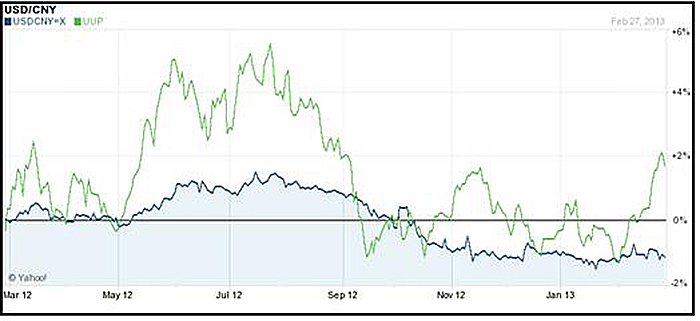
What transpired during 2012 to cause these changes, and what can we expect in 2013? In April of 2012, the People’s Bank of China announced a widening of the control bands on the yuan from one-half to a full percent. Predictions were mixed as to what the immediate impact might be, but the yuan actually weakened in the months that followed due to a declining demand for its exports from North America and Europe. U.S officials had hoped to see the Yuan appreciate, a position more reflective of the enormous foreign exchange reserves that China has accumulated from Western economies.
As the presidential campaign heated up in the United States, both candidates had stated negative opinions about the ongoing trade imbalance with China and what policies they supported that would deal effectively with the issue. The yuan began to appreciate rapidly in September, followed by a central bank fixing of 6.3028, a move many critics suggested was taken to blunt the adverse campaign rhetoric in the States.