
Advertisement
Macroscope
Opinion
Jayant Menon

Macroscope | Why Southeast Asian economic growth is safe from Covid-19 Delta ravages, for now

  • As long as government spending remains robust and monetary policies accommodative, the Delta outbreak in the region is unlikely to arrest its growth momentum
  • But if the pandemic is significantly prolonged, long-term economic scarring, as reflected in a rise in unemployment and poverty rates, is the more worrying danger

Reading Time:3 minutes
Why you can trust SCMP
1
Security officers turn away people at a vaccination centre in Metro Manila’s Las Pinas City, in the Philippines, on August 6. Whether the Delta variant prolongs the pandemic appreciably will depend on how long it takes to address the inequities in the production and distribution of vaccines globally. Photo: EPA-EFE
New coronavirus variants are producing some of the worst outbreaks seen during the pandemic in many countries in Asia, especially Southeast Asia. Not only is the Delta variant more virulent than previous ones, its high transmissibility is raising concerns that it will spawn new variants that may eventually compromise the efficacy of current vaccines.

This has led some to wonder whether the Delta variant marks a new beginning, rather than the beginning of the end, of the pandemic, raising concern that nascent economic recoveries in the region could be derailed.

Conflicting signs are emerging from forecasters. In August, HSBC reduced full-year growth estimates significantly for all major Southeast Asian economies except Singapore. The Asian Development Bank was less pessimistic in its July revision of its April forecasts, downgrading its growth outlook for the Asean region only marginally, from 4.4 per cent to 4 per cent for 2021.

Advertisement

Strong growth was reported in the second quarter of 2021, after either negative or flat growth in the first quarter, on a year-on-year basis. The countries with the deepest recessions or the sharpest drops in the second quarter of 2020 recorded the strongest rebound in the corresponding quarter of 2021 (the gains came off the low bases of 2020).
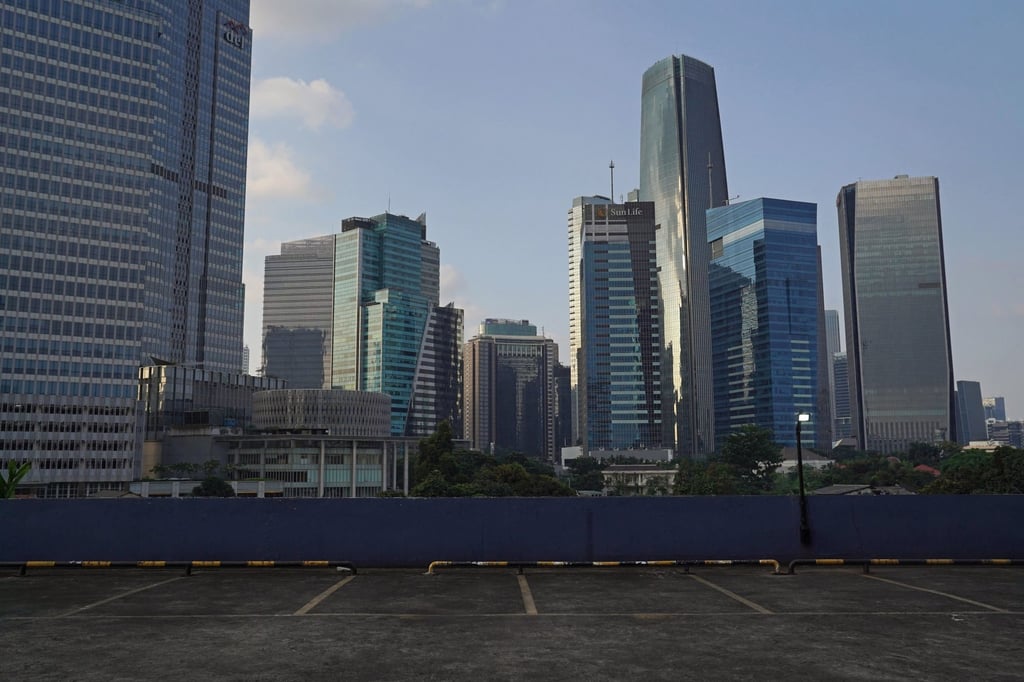
A deserted car park in the central business district of Jakarta on August 4. Indonesia pulled out of a recession in the second quarter but the rise in coronavirus cases and the mobility restrictions threaten the recovery momentum in the third quarter. Photo: Photo: Bloomberg
Malaysia registered growth of 16.1 per cent, the Philippines 11.8 per cent, and Singapore 14.7 per cent. Thailand is the exception, with modest growth of 7.5 per cent, as it struggles with a tourism downturn and, like Malaysia, domestic political turmoil.
Advertisement
Advertisement
Select Voice
Choose your listening speed
Get through articles 2x faster
1.25x
250 WPM
Slow
Average
Fast
1.25x