-
Advertisement
Opinion

With a lack of carers in Hong Kong, who will look after us as we grow older?

Mimi Zou and Jennifer Lee Shoy say our ageing society means the problem of labour shortages in residential homes is likely to get worse, and this will put the quality of care at risk

Reading Time:3 minutes
Why you can trust SCMP
Hong Kong’s elderly are expected to account for over 30 per cent of the population by 2041. Photo: May Tse
Advertising partner

Although the Hong Kong administration has been promoting a policy of “ageing in place” to encourage the elderly to live at home, there is an ever-increasing demand for residential care homes. According to the Elderly Commission’s report in 2009, Hong Kong’s institutionalisation rate for those aged 65 or above was 7 per cent, far higher than in mainland China (1 per cent), Taiwan (2 per cent), Japan (3 per cent) or Singapore (2.3 per cent).

READ MORE: ‘Disappointing year’ for Hong Kong’s elderly as progress remains slow on retirement protection and care home regulation

By 2041, our elderly population is expected to rise to 2.56 million (or over 30 per cent of the population). Our labour force is projected to shrink to 3.51 million by 2035. This highlights the need to develop a coherent framework of elderly care policies and regulations to meet not only existing challenges but what lies ahead.
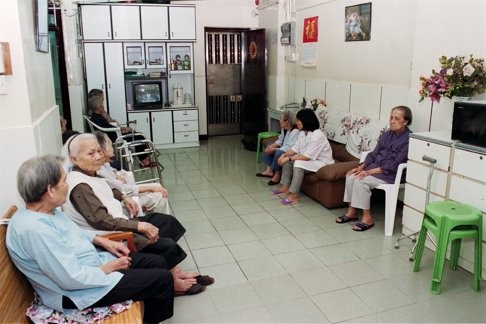
At Foo Yan Home, a private care centre for the elderly in North Point, just four staff look after 30 elderly people. It is one of many private centres in Hong Kong which is unable to provide enough carers, nurses or therapists for the elderly. Photo: SCMP
An ageing population has significant implications for current and future demand for long-term care. The primary form of long-term institutional elderly care in Hong Kong is residential care homes, which include a broad range of elderly hostels, aged homes, care and attention homes, nursing homes and infirmaries. The number of private care homes has doubled, from 256 in 1990 to 546 (licensed) homes in 2015.

While discussion of institutional elderly care has focused on the availability of places, funding and standards, an underexamined but important issue is the workforce providing such care. The Director of Audit’s 2014 report noted that “manpower shortage” is a major problem facing many care homes in the private sector.
Advertisement
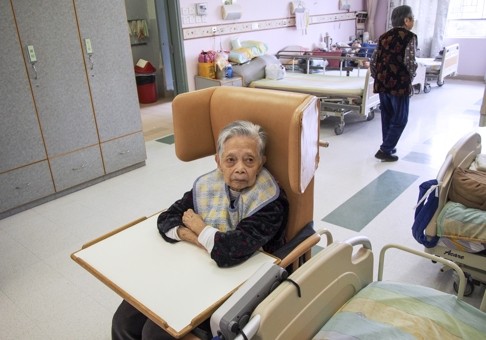
Ho Yuk, in her late 90s, at an elderly care home in Hong Kong. Photo: Aaron Tam
Labour shortages in this sector exist across skilled and lower-skilled occupations. A survey in 2015 showed that a third of physiotherapist jobs in nursing homes remain vacant. For lower-skilled jobs, a Legco briefing paper indicated there were around 1,000 vacancies among 8,100 non-professional frontline care work positions in care homes in 2012. Some recent policy responses have included: sponsored training programmes for enrolled nurses, development of a qualifications framework for the sector, increased public-funded university places for occupational therapy, physiotherapy and nursing, and a “first hire, then train” scheme for young care workers. A steering committee has also been established to conduct a strategic review on health care manpower planning and professional development.
Staffing shortages have prompted policymakers to consider other options, including migrant workers

Staffing shortages have prompted policymakers to consider other options, including migrant workers. Private care homes are permitted to recruit such workers to serve elderly residents in non-subsidised residential care service places. But there is hardly any available data on the number of migrant care workers employed in elderly care homes. One Legco source in 2011 indicated that private care homes employed around 4,950 workers, of which 934 were migrants.

Advertisement
Advertisement
Select Voice
Select Speed
1.00x