Why rising power Beijing must take note of long US shadow over South Korea
Jaeho Hwang says the overall trend of China-Korea ties is on the rise, despite the Thaad fallout, but Beijing will need to win international consensus to truly replace Washington as a stabilising force for Seoul

I have attended several security forums in Western countries where the focus of all discussion was China. The war of words between the collective West, led by the United States, and China reminded me of the Feast at Hong Gate (Hongmenyan), a historical event during the Chu-Han contention in ancient China. Chu’s leader Xiang Yu invited his nemesis Liu Bang and his men to a banquet at Hong Gate, during which Xiang’s cousin, Xiang Zhuang, performed a sword dance in a bid to assassinate Liu, and Xiang’s uncle, Xiang Bo, joined in to thwart the attempt.
The Xiangshan Forum, held in Beijing from October 10-12, was different in many ways, though China and Russia made an unexpected move when they publicly opposed the deployment of the US-led anti-missile system. The move, on the sidelines of the forum, left the impression that China was hiding a dagger behind its smile. Nonetheless, to get back to the analogy of the Hong Gate feast, the forum featured more drink-sharing than sword-waving, with Beijing’s military leadership presenting strategic dialogue and mutual trust as its central agenda.
China and Russia close ranks against US missile-defence system
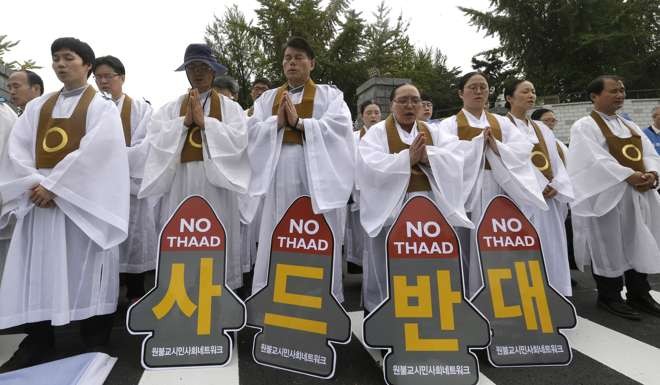
South Korea’s President Park calls for unity over ‘inevitable’ THAAD deployment
In February, Chinese Foreign Minister Wang Yi ( 王毅 ) likened the US to Xiang Yu for enticing South Korea to deploy its Thaad system, and his own country to Liu Bang. Then, taking the South’s current national standing into account, which figure from the Chu-Han era would best represent it? Seoul is in no way a Xiang Zhuang, as it never targets Beijing directly. Xiang Bo, who influenced Xiang Yu’s key decisions to Liu’s benefit, is not an appropriate choice, either.
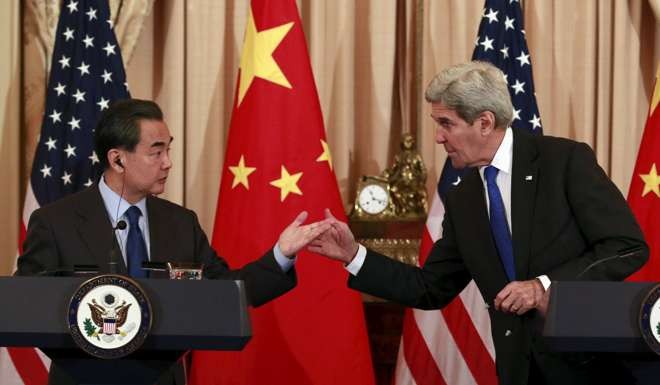
Washington’s THAAD missile system making Beijing nervous, Chinese Foreign Minister Wang Yi tells John Kerry in Munich
The appropriate figure for South Korea did not take centre stage in the story. It is Ji Bu, a Chinese general who served Xiang Yu. Chivalrous and brave, he was a man of his word. If China likens itself to Liu Bang, it should treat South Korea the way Liu treated Ji. After Xiang Yu’s defeat, Ji achieved many great deeds for Liu’s empire.