Advertisement
China pollution
Opinion

Deadly smog shows why China must clean up its act on battling pollution

Paul Yip says polluting first and cleaning up later is no longer a viable model of development, and green concerns have to take priority over growth figures

Reading Time:3 minutes
Why you can trust SCMP
Paramilitary police officers and security personnel wearing masks patrol at Tiananmen Square amid a red alert for heavy air pollution in Beijing, on December 20. Photo: Reuters
Paul Yip

A recent visit to Beijing was a reminder of the cost and benefit of any economic development. Indeed, the spectacular growth rates of the past two decades have made China the world’s second-largest economy. But economic prosperity and rapid development has sadly come at the expense of the environment.

While development and increased opportunities have improved the quality of life for many, some side effects of rapid economic growth are emerging. The entire population has not shared the benefits of growth – the wealth gap is widening and housing affordability is a concern for the younger population.

The government has made considerable efforts to redistribute wealth and provide assistance to vulnerable groups. However, there is one sticking point – air pollution, which can have seriously harmful effects on health and well-being.

Watch: Red alert for severe air pollution in China
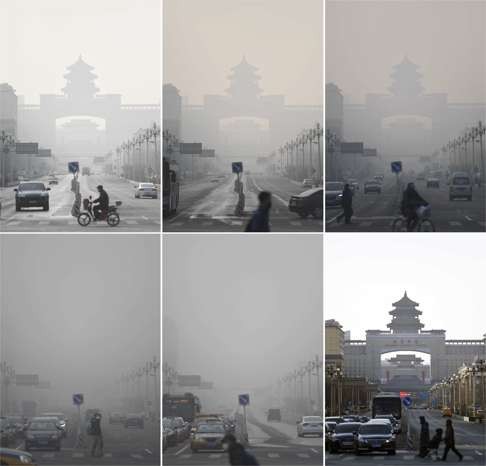
The government has in the last several years earmarked billions of yuan for fighting air pollution, but the situation has not improved. In Beijing, a red alert for heavy smog saw schools told to close and half the vehicles ordered off the road. This was done so as to not exacerbate the pollution. The smog caused traffic accidents and my flight was delayed for hours. The economic and health cost to the community has yet to be fully evaluated.
Advertisement
The Beijing West Railway Station, pictured December 17-19 (top row, left to right), and then December 20-22, shows how smog enveloped the city and was then dispersed when cold air moved through. Photo: Xinhua

Officials must be fully committed to clearing the air

The water is polluted, the land is contaminated and smog can kill. The sulphur dioxide and nitrogen dioxide produced by power plants and automobiles, and ammonia from fertiliser use, along with a windless cold weather helped the build-up of smog, with more than 20 cities in northern and central China issuing red alerts. This has triggered many health complaints, especially respiratory problems.

How China’s quick blue-sky fixes make pollution worse

The infamous London smog of December 1952 killed at least 4,000 people in five days, but continuous efforts to fight pollution have now made the British capital one of the world’s most liveable cities. China’s equally populous neighbour, India, is investing in green solar energy.
Advertisement
Select Voice
Choose your listening speed
Get through articles 2x faster
1.25x
250 WPM
Slow
Average
Fast
1.25x