-
Advertisement
Opinion

Hong Kong’s plan for bigger health warnings on cigarette packs is backed by solid research

Geoffrey Fong says studies over the years and in many countries demonstrate the effectiveness of bigger warning labels and a ‘quitline’ in empowering smokers to give up, while motivating youth not to take up the harmful habit

Reading Time:4 minutes
Why you can trust SCMP
Geoffrey Fong says studies over the years and in many countries demonstrate the effectiveness of bigger warning labels and a ‘quitline’ in empowering smokers to give up, while motivating youth not to take up the harmful habit
Geoffrey T. Fong
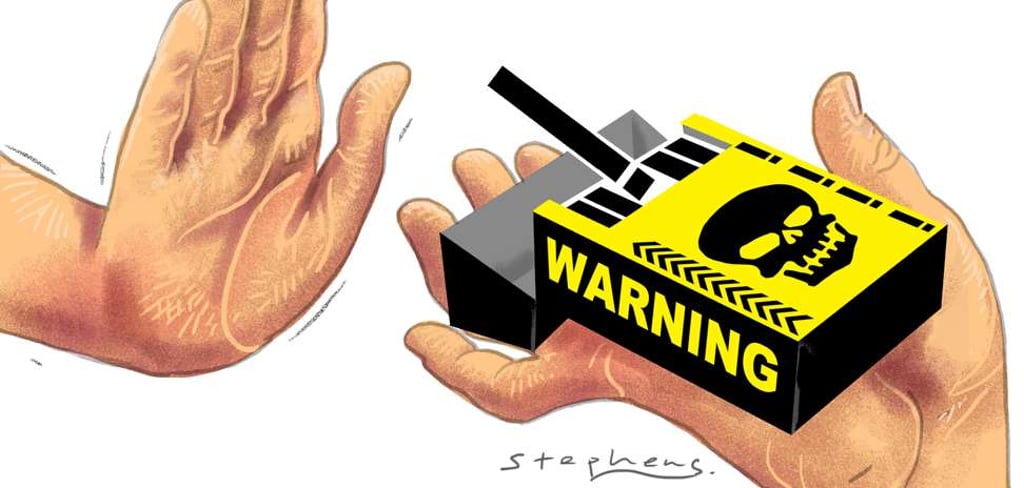
There is strong research evidence corresponding with common sense that larger warnings have greater impact. Illustration: Craig Stephens
Tobacco products cause more deaths in Hong Kong and throughout the world than any other single preventable cause. Governments have a legal and moral responsibility to warn its people about the extreme dangers of these products. Warning labels – particularly large warnings with graphic images – have been proven to raise awareness of the harm of tobacco and second-hand smoke, increase motivation among smokers to quit, and discourage youth from taking up smoking.

In 2007, Hong Kong became one of the first jurisdictions in Asia to implement graphic warnings on tobacco packaging, occupying 50 per cent of the pack. However, these warnings have remained unchanged on the pack for a decade.

But this is about to change. This week, the Hong Kong government is tabling a law calling for an increase in size of its warnings from 50 per cent to 85 per cent of the pack, doubling the number of warnings, from six to 12, and adding the hotline number for smokers who want to quit.

Hong Kong vendors warn of protests if larger warnings are printed on cigarette packs

Studies from the International Tobacco Control Policy Evaluation Project provide evidence supporting these proposed changes. Beginning in 2002, the project has conducted research in 28 countries, covering over half of the world’s population, including China, South Korea, Thailand, Malaysia, India, Bangladesh, Australia and New Zealand within the Asia-Pacific region, to evaluate the impact of tobacco control policies. We have conducted over 60 studies of the impact of warning labels, and a number of these studies have measured what happens when governments revise their warnings, such as introducing graphic images, changing the positioning of the warnings on the pack, and increasing the size.
Advertisement

First of all, there is a clear need to revise the warnings in Hong Kong because of the “wear-out” effect – messages that are repeated over time lose their impact and need to be refreshed. The studies showed the wear-out effect of warnings across a diversity of countries, including Canada, the United States, Australia and Mauritius. Canada was the first country to introduce pictorial warnings in 2001, when it implemented 12 graphic warnings taking up 50 per cent of the pack. But from 2002 to 2011, noticing the warnings dropped by over 25 per cent, their impact on thinking about the risks of smoking dropped by 35 per cent, and the impact on thinking about quitting dropped by nearly half.

Advertisement

However, when Canada revised its warnings in 2012, including increasing their size from 50 per cent to 75 per cent of the pack, the number of smokers reporting that the warnings made them think about quitting doubled.

Hong Kong’s warnings have remained unchanged for nearly a decade, well beyond the two to three years that the World Health Organisation and leading authorities recommend as the interval for revising warnings. Indeed, of the 12 jurisdictions that had introduced graphic warnings by 2007, Hong Kong is the only one that has not revised them. Thailand has revised its graphic warnings three times; Panama has done so six times.

Advertisement
Select Voice
Choose your listening speed
Get through articles 2x faster
1.25x
250 WPM
Slow
Average
Fast
1.25x