Advertisement
Opinion

Hong Kong needs to better address age discrimination in the workplace

Lina Vyas says general policies to extend the working lives of older employees are woefully lacking in Hong Kong despite its greying demographic, and real change can only come with age discrimination legislation


Reading Time:3 minutes
Why you can trust SCMP
Lina Vyas says general policies to extend the working lives of older employees are woefully lacking in Hong Kong despite its greying demographic, and real change can only come with age discrimination legislation
Lina Vyas
Job ­insecurity and low-status, poorly paid positions can damage the health and well-being of older workers. Illustration: Craig Stephens
The ageing of populations is an unparallelled global occurrence, generating concern about labour and skills shortages in many countries. One way to ­address these concerns is to extend the working lives of older people through appropriate retirement, ­retention and recruitment policies.

Hong Kong only has a mandatory retirement age for the civil service, but most other sectors take this as a valid reference in establishing their retirement-age policies.

Longer and secure working lives lead to greater opportunities for ‘active ageing’

Since 2015, the government has taken active measures to extend civil servants’ retirement age.

Advertisement
This includes extending the ­retirement age of new recruits to 65 (60 for the disciplined services) primarily against the backdrop of an ageing population. For existing ­employees, the status quo ­remained until very recently, that is, compulsory retirement at 60 for general civil servants, and 55 for the disciplined services.

Recently, the government has made provisions to allow them to stay on beyond the retirement age, subject to approval by heads of department, for a further 12 months, up to a maximum of five years in total. The new mechanism is long overdue and has just been announced, despite an earlier Legislative Council paper stating that implementation would be finalised within the first quarter of 2016.
Advertisement
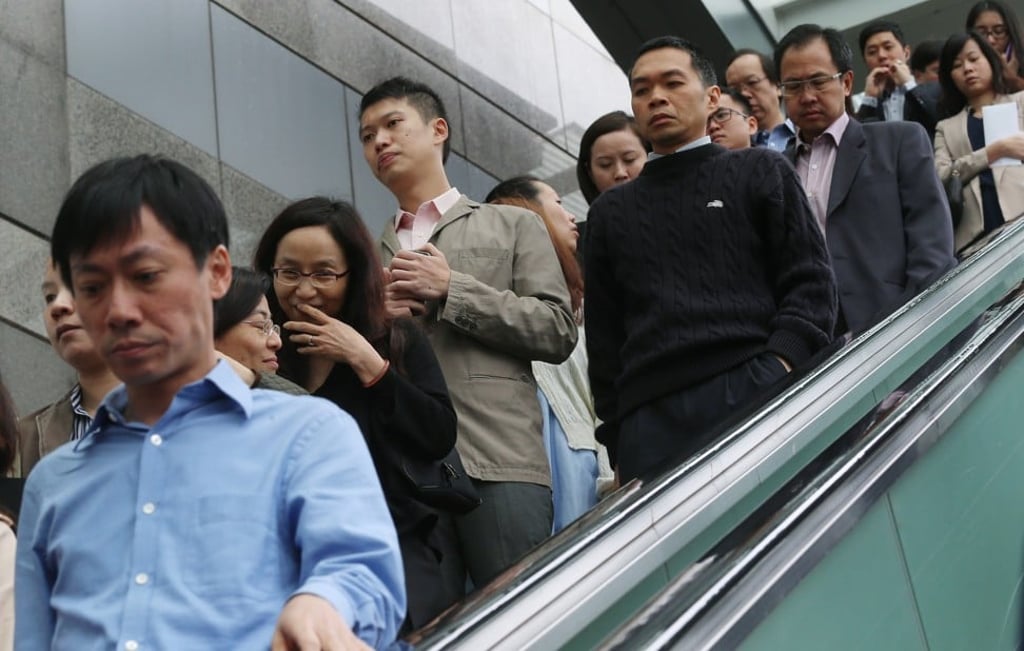
Employees finish work at the government headquarters at Tamar. Though Hong Kong only has a mandatory retirement age for the civil service, most other sectors take this as a valid reference point for their own retirement-age policies. Photo: K.Y.cheng
The new policy comes in response to calls from staff unions to extend the retirement age, and is in line with global trends. One major shortfall of the mechanism, however, is that it gives the line manager immense power and control over the fate of applicants. Moreover, those applying for an extension are denied the prospects of promotion.

Longer and secure working lives lead to greater opportunities for “active ageing”. Conversely, job ­insecurity and low-status, poorly paid positions can be damaging to the health and well-being of older workers.

Advertisement
Select Voice
Choose your listening speed
Get through articles 2x faster
1.25x
250 WPM
Slow
Average
Fast
1.25x