Advertisement
Occupy Central
Opinion

Politics played no part in Hong Kong court’s decision to jail young activists

Grenville Cross says the appeals court was right to overrule the initial, more lenient sentences that gave undue weight to the activists’ political motivation, a violation of the principle that all are equal before the law

4-MIN READ4-MIN
For as long as it remains the case that everyone is equal before the law, there cannot be one type of sentence for political activists and another for other lawbreakers. Illustration: Craig Stephens
Grenville Cross
Earlier this month, the Court of Appeal sentenced three young men to imprisonment for between six and eight months, for their involvement in an unlawful assembly. This occurred at “Civic Square”, outside the government headquarters in Central, in September 2014.

The offence of unlawful assembly is punishable with up to five years’ imprisonment, and is treated seriously. It arises where three or more people have assembled together and behaved in a disorderly, intimidating or provocative way, intended or likely to cause any person to reasonably fear that the assembled people will commit a breach of the peace, or will provoke others to commit a breach.

The evidence at trial showed that the men stormed a restricted area, and incited others to do likewise. Force was used to prise open closed gates, which were being guarded by security guards and police officers. The barriers around the flagpoles were pushed over and other people were encouraged to invade the restricted area.

Advertisement

In the melee, 10 security guards sustained injuries. Although these were not, for the most part, serious, one security officer sustained a slight fracture to his first phalanx, and had to take 39 days of sick leave.
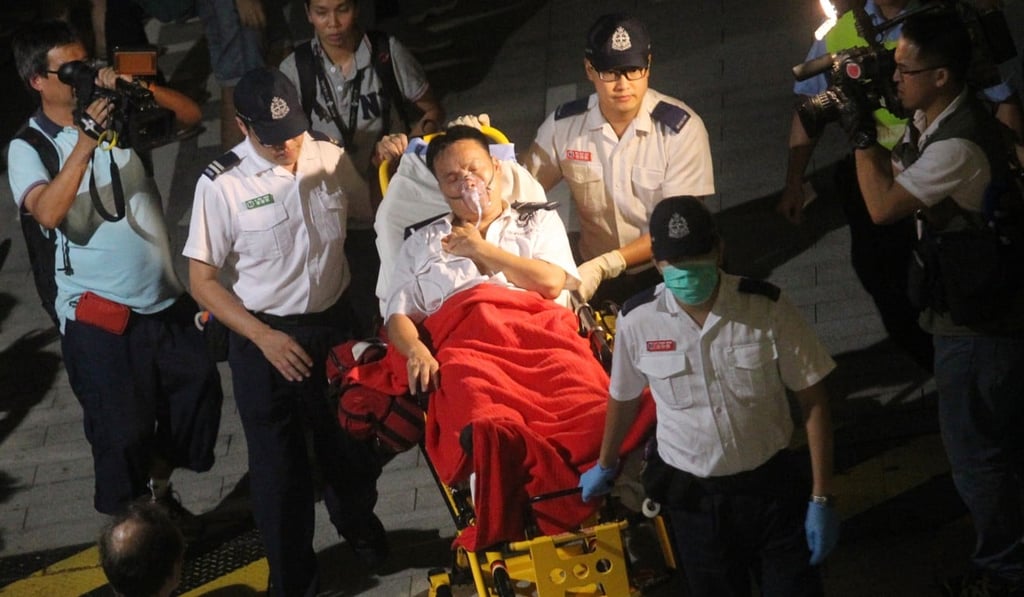
A security officer hurt during the melee on September 26 is taken to hospital. Photo: May Tse

Read the Hong Kong Court of Appeal’s ruling on Joshua Wong, Nathan Law and Alex Chow

Although this was a serious public order offence, the trial magistrate failed to reflect this in her sentences. She imposed community service orders on two of the men and a short suspended prison sentence on the third. While there is always scope for leniency in sentencing, the magistrate disregarded the need for condign punishment as a deterrent in cases where large-scale public disorder involves violence and injury. She treated the political motives of the men as a basis for not imposing tougher sentences, and thereby misdirected herself.
Advertisement
Select Voice
Select Speed
1.00x