Advertisement
Opinion

How Chinese innovation can spur economic growth in Africa

Jean-Claude Bastos de Morais says Africa can learn from China’s continued economic expansion, and tap into its rich reserves of human capital, through investment by governments, non-profits and the private sector to achieve self-sustaining growth

Reading Time:3 minutes
Why you can trust SCMP
A security guard patrols during the launch of the first batch of Standard Gauge Railway (SGR) freight locomotives at the port in Mombasa last January. The SGR system, the biggest infrastructure project in Kenya since independence, is being built by the state-owned China Road and Bridge Corporation, with plans to connect Kenya, Uganda, Rwanda and South Sudan to Mombasa. Photo: AFP
Jean-Claude Bastos de Morais
China’s economic success has been the envy of the world in recent decades. Its GDP grew by an average of 9.71 per cent between 1989 and 2017. The country’s story has evolved in tandem with three key factors: steady deregulation, major investment in infrastructure and a surge in innovative technologies. These three factors have proven throughout history to be reliable liberators of economic growth – but can the same be applied thousands of miles away in one of the world’s most complex regions, sub-Saharan Africa?

Africa – a region of 54 countries – is separated by thousands of miles of terrain, complicated political histories and anywhere between 1,000 and 3,000 languages. It also has significant socioeconomic challenges such as access to education, infrastructure, poverty and life expectancy. Yet Africa and China have much in common.

China and Africa both have huge populations, which in the pursuit of industrialisation and economic growth is hugely important. Between them, over a third of the planet’s people live in either Africa and China – 2.6 billion. Of these, 1.2 billion live in Africa. Unlike China however, Africa has an extremely young population – and it is the fastest growing in the world. This provides the African continent with the richest source of human capital in the world – but it must be nurtured.
Advertisement
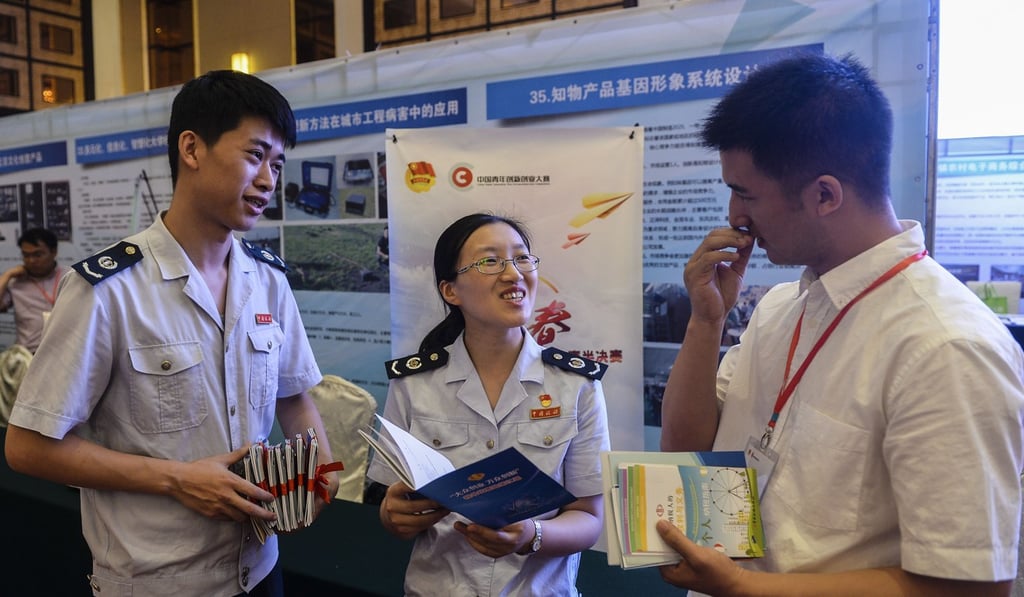
Staff from Zhangjiagang Local Taxation Bureau introduce preferential tax policies to a young entrepreneur during the Jiangsu youth innovation and entrepreneurship competition in Zhangjiagang City on August 2. Photo: Xinhua
China’s story illustrates how important it is for human capital to be nurtured. At a 2016 event combining the national conference on science and technology, the biennial conference of the Chinese Academy of Sciences (and the Chinese Academy of Engineering, President Xi Jinping said that, “China should establish itself as one of the most innovative countries by 2020 and a leading innovator by 2030”. He went on to say that, “Great scientific and technological capacity is a must for China to be strong and for people’s lives to improve.”

China’s telecoms giants march to the beat of national service

This is as true for Africa as it is for China. The emphasis in both countries must be to push enterprise from the grass roots. Government zeal is key and, in Africa, there is a rapidly growing understanding among policymakers that innovation – and the support of innovation – is critical. Therefore, investment in innovation ecosystems and infrastructure in Africa must be a key priority.

Advertisement
Advertisement
Select Voice
Choose your listening speed
Get through articles 2x faster
1.25x
250 WPM
Slow
Average
Fast
1.25x