-
Advertisement
Drugs
Opinion

Asia’s violent anti-drug crackdowns are hurting people, not the drug trade

Ruth Dreifuss, Fernando Henrique Cardoso and Olusegun Obasanjo say that governments in Asia should look away from coercive means, like the death penalty and long prison sentences, and towards voluntary rehabilitation

Reading Time:3 minutes
Why you can trust SCMP
The family of Ephraim Escudero, a victim of extrajudicial killing in the Philippines, mourn during his burial at a cemetery in San Pedro city on September 30. President Rodrigo Duterte's war on drugs has killed more than 7,000 people since his election last summer, with polling showing most of the public believe the police have carried out extrajudicial killings. Photo: EPA-EFE
Ruth Dreifuss,Fernando Henrique CardosoandOlusegun Obasanjo
With regional and international heads of state gathering in Manila for the 31st Asean Summit from November 10-14, it seems appropriate to examine whether there are more effective drug policies for dealing with the harms caused by the presence of drugs in society.
As former heads of state from Africa, Europe and Latin America, we recognise the fear many communities feel, and the distress of policymakers in dealing with drugs. Sadly, however, this distress has too often resulted in punitive drug policies based on repression, with a view of completely ridding society of drugs.
The aim of a “drug-free society” has not always dominated the public and political landscape in Southeast Asia. In several countries, traditional uses of some drugs such as cannabis, opium or kratom were tolerated and accepted. Indeed, the current prohibitionist international drug control regime is largely a Western construct, based on the United Nations conventions and political declarations, advancing a “drug-free society” as an objective.
Advertisement
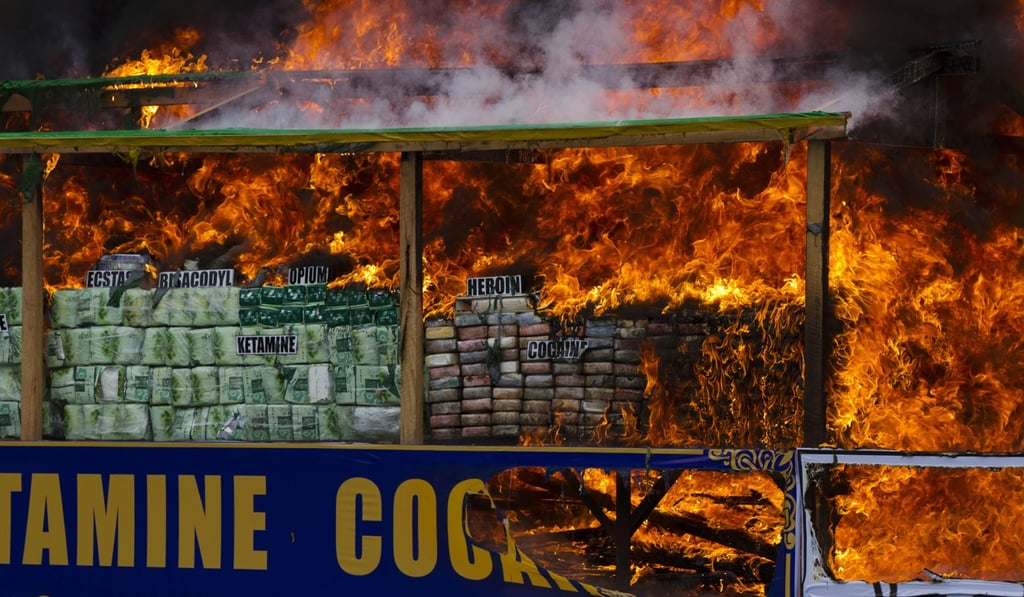
Smoke and flames billow from a destruction ceremony for seized narcotics on the outskirts of Yangon, Myanmar, in June. Authorities destroyed the drugs to mark the International Day against Drug Abuse and Illicit Trafficking. Photo: AP

Seizures of yaba, Asia’s ‘crazy medicine’, shoot up in Myanmar’s crisis-hit Rakhine

This objective has not been achieved. The vision for a “drug-free Asean by 2015” did not materialise for the most part because the aim was unrealistic, not because the level of repression was not high. More than five decades of prohibition have shown that harsh penalties are no more dissuasive in curbing drug use than more proportionate sentencing. Furthermore, harsh penalties for non-violent drug offences dehumanise people who use drugs and undermine the dignity not only of those convicted but also of those who have to apply such laws.

Advertisement
Advertisement
Select Voice
Select Speed
1.00x