Advertisement

The friendship between Trump and Xi is a boon for US-China relations, whatever the US media says

Chi Wang says the US president’s embrace of Xi Jinping’s welcome in Beijing reflects a personal warmth sorely missing in bilateral ties, bringing hope for more substantive cooperation to come

Reading Time:4 minutes
Why you can trust SCMP
Chi Wang says the US president’s embrace of Xi Jinping’s welcome in Beijing reflects a personal warmth sorely missing in bilateral ties, bringing hope for more substantive cooperation to come
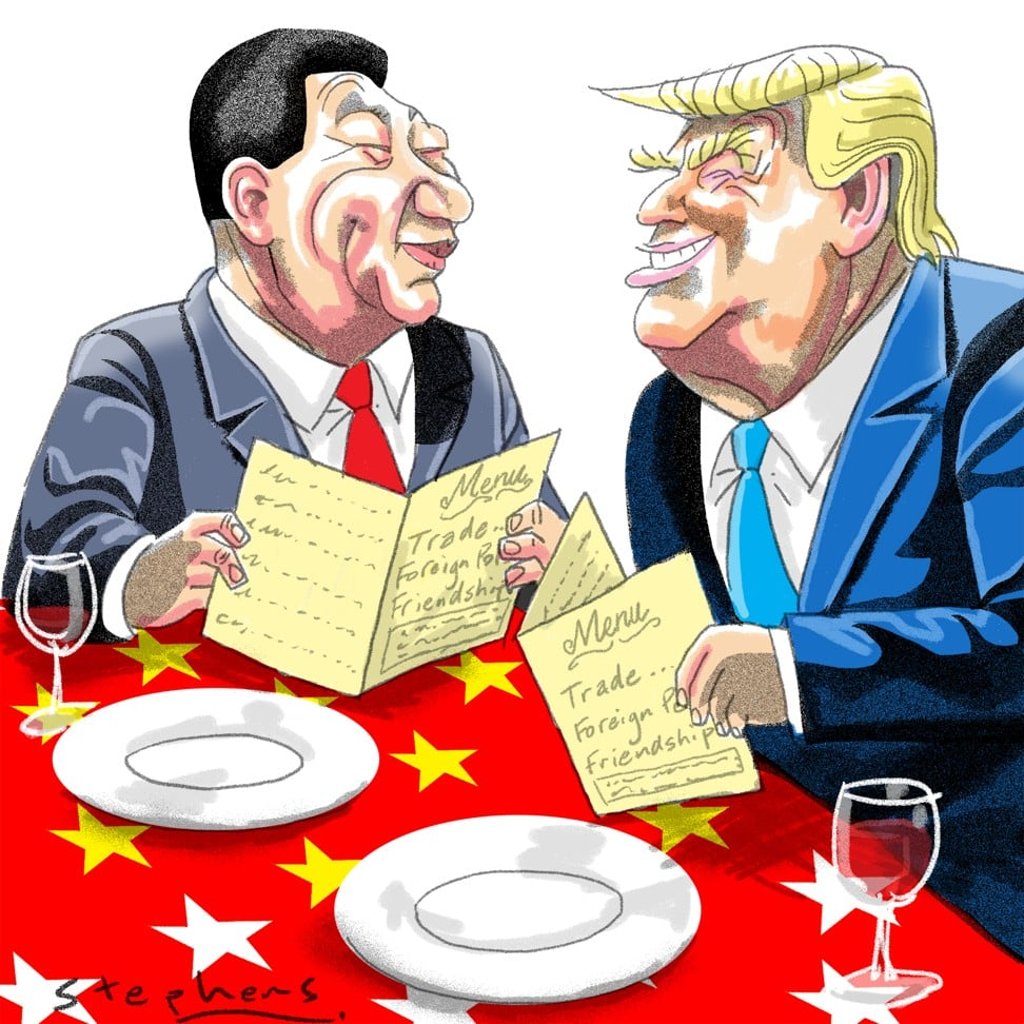
The warm welcome Xi gave to Trump during his time in Beijing was indicative of both leaders’ desire for cooperation and friendship after years of cooling relations. Illustration: Craig Stephens
Of all the stops in President Donald Trump’s five-country trip to Asia earlier this month, his visit to Beijing was both the most highly anticipated and the most soundly criticised leg of the journey. Chinese ambassador to the US Cui Tiankai promised that Trump’s visit would be a “state visit plus”, and Chinese hosts delivered on their promise: President Xi Jinping welcomed Trump with warmth and honour befitting a major world leader – and an ally. Following his visit to Mar-a-Lago earlier this year, Xi returned Trump’s own friendly welcome.
The dinner shared between Trump and Xi in Jianfu Palace was the first time a foreign head of state has dined in the Forbidden City since the founding of the People’s Republic of China. This, along with the march held in Tiananmen Square, drew the most attention from American media. As Trump thanked his host (even changing his Twitter banner to a picture of himself and Xi with their wives), news outlets criticised both him and Xi for laying on the pomp and circumstance or the ceremony of a state visit, rather than focusing on substantive results.

CNN reporters even claimed that “staging mattered as much as the policy”, or that Trump’s embrace of the welcome simply overshadowed anything else – completely overlooking that any “overshadowing” of policy was done by the media itself.

China has not had particularly positive perceptions of most US presidents past

The warm welcome Xi gave to Trump during his time in Beijing was indicative of both leaders’ desire for cooperation and friendship after years of cooling relations. Susan Rice, the former national security adviser to Barack Obama, criticised Trump for his “embarrassing accolades”, but for all her talk, Obama accomplished very little in China during his own time in office. He certainly lacked a cooperative relationship with Xi himself. Former Mexican ambassador to China Jorge Guajardo claimed Xi was “playing Trump like a fiddle”, but then admitted to having often been poor at reading his meetings in China himself. Other China academics, such as Bonnie Glaser with the Centre for Strategic and International Studies, called it “flattery” that is unlikely to produce concrete progress for the US. Evan Medeiros, another former Asia adviser to Obama, suggested that Trump’s friendship with Xi might end up “inadvertently ceding American primacy” to China.

Advertisement

This is hyperbolic. It completely ignores the context of previous positive US-China relationships. Even Dennis Wilder, formerly the CIA’s deputy assistant director for East Asia and the Pacific, acknowledged that establishing personal ties “has been important in US-China relations ever since Mao [Zedong] and [Richard] Nixon”. And we know Nixon’s success in China was not simple lip service. Personal diplomacy works.

China has not had particularly positive perceptions of most US presidents past: Nixon and Jimmy Carter, of course, were responsible in helping to advance China’s opening on the global stage, and even Bill Clinton did well in China. However, US state visits to China have historically often been tense and inharmonious, especially when used as opportunities to attack China on sensitive issues such as liberal democracy and human rights. Trump, on the other hand, was greeted in Tiananmen Square with calls of Telangpu yeye (Grandpa Trump). His granddaughter learned and sang songs in Mandarin for Xi, earning praise from Chinese people. Trump is well liked by the Chinese public, who feel more positive towards the US-China relationship than they have in years.

Watch: What Beijing residents think of Trump

Advertisement
Select Voice
Choose your listening speed
Get through articles 2x faster
1.25x
250 WPM
Slow
Average
Fast
1.25x