Russia-India-China meeting shows a multipolar world order is taking shape
C. Uday Bhaskar says this week’s meeting of Russian, Indian and Chinese foreign ministers was not marked by complete agreement, but still reveals the fulfilment of the grouping’s promise – an end to unipolar US dominance
The 15th trilateral meeting of the foreign ministers of Russia, India and China concluded in New Delhi on Monday with many nuanced takeaways embedded in the joint statement of 46 paragraphs. Reiterating that the forum “is not directed against any other country”, the statement underlined the importance of the establishment of a “just and equitable international order based on international law and featuring mutual respect, fairness, [and] justice in international relations”.
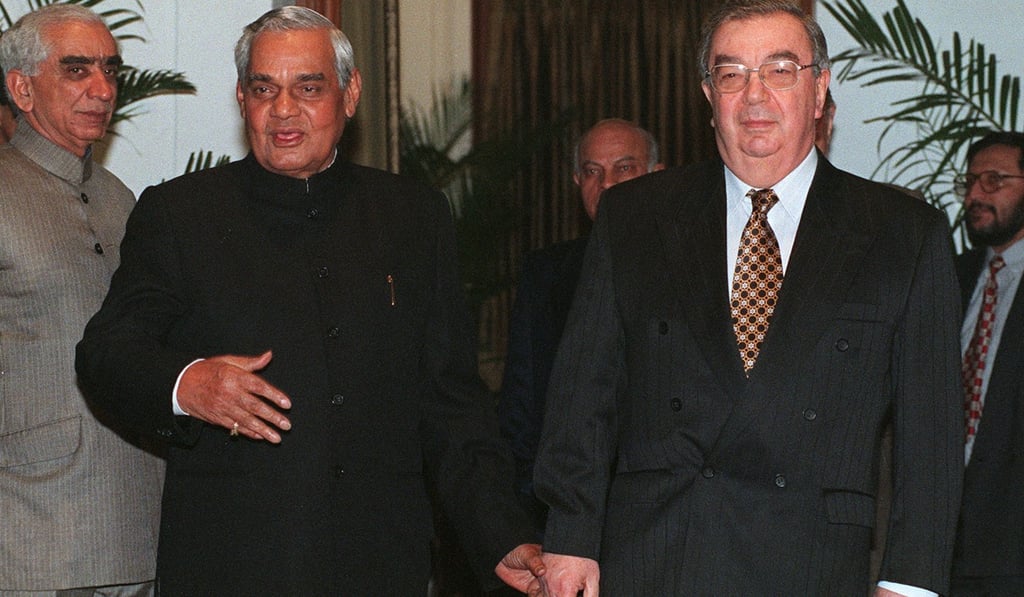
The grouping has met formally since 2002 at the foreign-minister level and has its origin in the “Primakov triangle”. This author recalls Yevgeny Primakov, the Russian foreign minister who later became its prime minister, visiting Delhi in the mid-1990s and noting the imperative for the three nations to create such a forum.
Russian Prime Minister Yevgeny Primakov, right, meets Indian Prime Minister Atal Bihari Vajpayee in New Delhi in December 1998. In the 1990s, Primakov was an early promoter of a Russia-India-China forum to counter US hegemony. Photo: AP
The geopolitical compulsion was the end of the cold war and its changes to the orientations of Moscow, Beijing and Delhi. The global strategic flux was compounded in the early 1990s by domestic turbulence. Beijing was coping with post-Tiananmen fallout; Delhi had a grave fiscal crisis, forcing it to move gold to the UK to remain solvent; and Moscow was shell-shocked by the loss of its empire.
Advertisement
The Primakov extrapolation was that the United States would emerge as the sole superpower after the USSR’s disintegration and a multipolar world order would be more desirable than a unipolar one dominated by US certitude and post-cold war swagger.
The very subtle formulation that one recalls two decades later is the wry observation by Primakov that the success of Russia-India-China cooperation cohering into a credible grouping would depend on the sagacity of their political leadership and their ability to develop a consensual degree of strategic equipoise – both bilaterally and trilaterally.
This was tested and displayed in Delhi, where the bilateral meetings and individual statements revealed a subtext rich in strategic import. The fact that the trilateral meeting took place even as Russia declared joint victory with Syria over Islamic State provided the appropriate context to commend Moscow for its counterterrorism initiative and to urge a “Syrian-led, Syrian-owned” solution. The isolation of the US in the UN Security Council over the Jerusalem announcement underscored the dilution of the traditional American leadership role in west Asia.