Advertisement

As Trump’s tax cut proposal proves, income inequality is rooted in our quest for simple truths

Andrew Sheng says the US tax cut proposal exemplifies an economic model that is rooted in Western civilisation’s fascination with universal theories. Within the logic of the free market, income inequality is brushed aside as an inconvenient outlier

Reading Time:3 minutes
Why you can trust SCMP
A demonstrator protests against income inequality in Denver, Colorado, in 2011.The recent US tax cuts are expected to benefit the wealthy and hit the needy hard. Photo: Reuters

The idea that human beings should be equal is very old. The fight against inequality between French citizens and the royalty drove the 18th-century intellectual Rousseau to write “Man is born free, but everywhere he is in chains”, sparking the French Revolution. In 1776, the newly independent United States of America wrote into its constitution, “we hold these truths to be self-evident, that all men are created equal”, although neither women nor slaves were considered equal. Nevertheless, by the 21st century, the view that all men are equal was taken as a truism, even though, to quote Orwell, “all animals are equal, but some are more equal than others.”

There are three “stylised facts” about global income inequality. First, the gap “between nations” has narrowed, mainly due to the rise of emerging markets. Second, the gap between the rich and poor has widened, especially in the past 30 years. Third, as the NGO Oxfam noted, the top eight billionaires own as much as the poorer half of mankind.

A tale of three US Fed misfits and the growing wealth gap
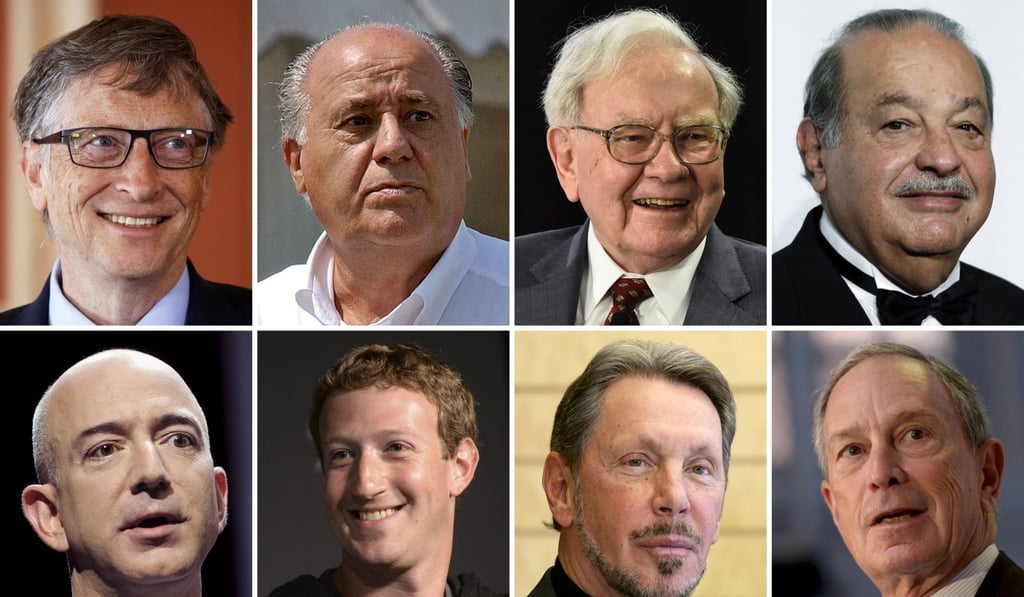
According to a report by Oxfam in 2017, eight people own as much wealth as about half of the world's population. The eight billionaires are (top, left to right) Microsoft founder Bill Gates, Inditex founder Amancio Ortega, US investor Warren Buffett, Telmex CEO Carlos Slim, (bottom, left to right) Amazon CEO Jeff Bezos, Facebook founder Mark Zuckerberg, Oracle founder Larry Ellison, and Bloomberg CEO Michael Bloomberg. Photo: EPA/DSK
Advertisement
Thomas Piketty’s Capitalism in the 21st Century showed that inequalities in wealth distribution have deep political roots. Since the Nobel Prize in Economics was inaugurated, only two awards have gone to studies on inequality, the rest to quantitative economics, efficient resource allocation and market theory. Why has inequality not been the centre of mainstream economics’ research agenda?

There are meta-economic reasons why economic theory, which began as “political economy”, switched to “pure science”. By the 1980s, economics became normative and quantitative, using mathematical models borrowed from physics which assumed away messy politics, rationalising the world in elegant theories that focused on optimal policy solutions but ignored uncertainties such as financial crises and social inequities.

In China’s richest province, a yawning gap exists between the haves and the have-nots
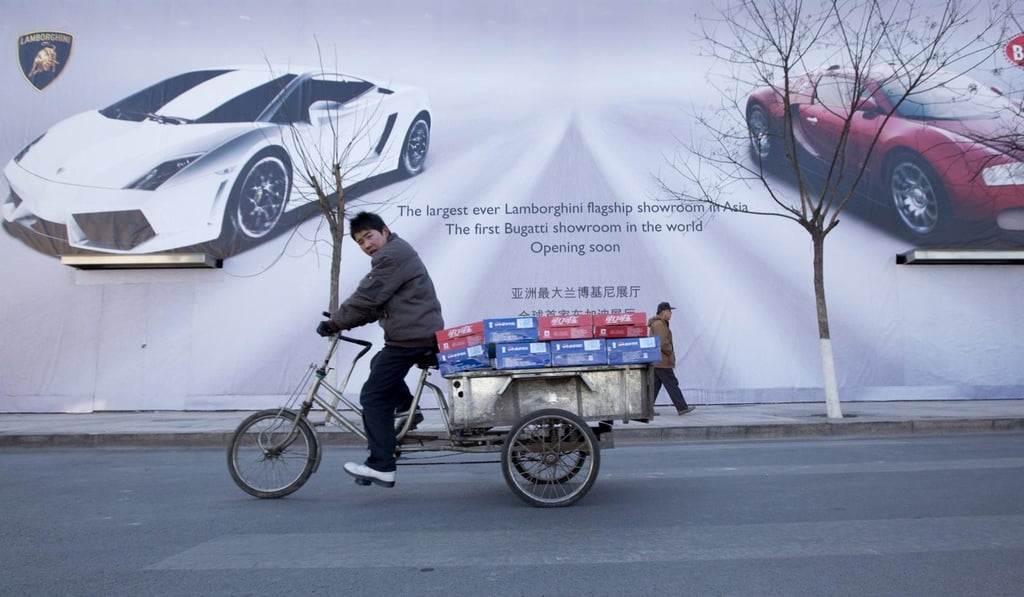
A cyclist passes an advertisement for a soon-to-be opened showroom for Bugatti and Lamborghini supercars in Beijing. While the wealth gap between nations is declining partly due to the rise of China, stark inequality persists within the country. Photo: EPA
The philosopher Stephen Toulmin categorised Western modernity (the rise of modern science) into three phases. The first was from 1436, when Gutenberg created typeset printing, to around 1650 which coincided with the discovery of America, the quest for trade with China after the loss of Constantinople, and the flowering of art, philosophy, literature and modern science.
Politics drives economic theory, which legitimises the status quo
Advertisement
Select Voice
Choose your listening speed
Get through articles 2x faster
1.25x
250 WPM
Slow
Average
Fast
1.25x