
Advertisement

Opinion | Donald Trump has a point on steel tariffs, but does he have a solution?

Robert Delaney says there are real concerns about acquisitions of steel and aluminium for the US military as it gears up to confront authoritarian powers abroad – but Trump’s tariffs are a poor solution

Reading Time:3 minutes
Why you can trust SCMP
US President Donald Trump listens during the National Prayer Breakfast in Washington on February 8. Trump used his speech to praise the US military and reiterate support for oppressed people in Iran and North Korea. Photo: Bloomberg
US President Donald Trump has built an enthusiastic domestic following on a middle finger aimed at the rest of the world. So major trading partners hitting back at his plan for import tariffs on steel and aluminium probably don’t rattle him.

But when Trump comes under attack from right-leaning publications like The Wall Street Journal and business-friendly Bloomberg News, the White House should worry. The Journal’s editorial board called Trump’s plan “the biggest policy blunder of his presidency” and “one of the greatest displays of economic nonsense in presidential history”.

Using historical trade data showing an inverse relationship between the size of the US trade deficit and economic growth, Bloomberg columnist Noah Smith took apart the argument that restricting imports leads to stronger GDP growth.

“If imports compete with domestically produced goods, they could cause GDP to go down, but if they represent inputs into supply chains for domestic production, then cutting them off would hurt growth”, Smith said, noting that steel and aluminium are key inputs into many American-made goods.

Advertisement
Still, there’s a kernel of common sense in Trump’s drive to protect US steel and aluminium producers. The contention that unfair competition from state-subsidised foreign metal undercuts America’s military capability deserves examination.

Explainer: what Trump’s tariff proposals mean for America
Firms making weaponry for the US armed forces require the highest grades of aluminium and steel. If reports that the United States is losing manufacturers of the metals needed to produce advanced military equipment to foreign competition are true, Washington should be expected to react, especially with the expansion of authoritarianism overseas and dire warnings from the US intelligence community that Russia launched a concerted campaign to influence the 2016 presidential election.
Advertisement
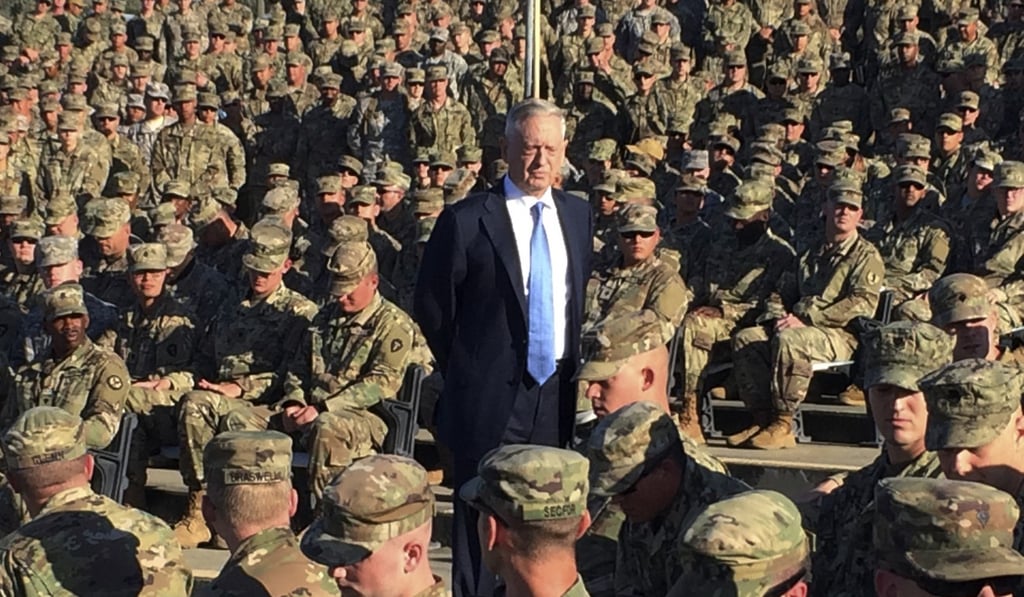
US Defence Secretary James Mattis talks to troops in Guantanamo Bay, Cuba. Mattis has called for, and received, an expanded military budget to counter the rise of China and Russia, and voiced support for “targeted tariffs” on steel and aluminium to counter trade practices that jeopardise the armed forces, but said a more general tariff or quota could antagonise US allies. Photo: AP
Advertisement
Select Voice
Choose your listening speed
Get through articles 2x faster
1.25x
250 WPM
Slow
Average
Fast
1.25x