
Advertisement
Pakistan
Opinion
C. Uday Bhaskar

Opinion | Pakistan’s economic woes, terrorism and complex foreign relations remain. Is a former cricket player up to the task?

C. Uday Bhaskar says Pakistan’s latest election has apparently chosen a former cricket player known for a poor attention span to lead a deeply divided country where a military, beholden to Islamic extremists, has pulled the strings for decades. Islamabad’s backers in Beijing and Washington must be wondering: what could go wrong?

Reading Time:3 minutes
Why you can trust SCMP
Pakistani cricket star-turned-politician Imran Khan declares victory in the general election in Islamabad. Photo: PTI handout via Reuters
The changing of the guard in a nuclear-armed state is of global relevance and the outcome of the violence-scarred July 25 Pakistan elections is no surprise. In the months preceding the election, the received wisdom was that the powerful Pakistani military that has ruled the nation for the last six decades – either directly after a military coup or from behind the electoral screen – had identified former cricket player and playboy Imran Khan as the next prime minister of Pakistan. And so it has come to pass.

At this time of writing, the PTI (Pakistan Tehreek-e-Insaf), led by the novice political leader Khan, is set to emerge as the single largest party in first-past-the-post elections for the 272 seats in the National Assembly. Coming in a distant second was the PML-N – short for Pakistan Muslim League (Nawaz) – led by the now-imprisoned former prime minister Nawaz Sharif. The PPP (Pakistan Peoples Party), led by the 29-year-old son of another former prime minister, the late Benazir Bhutto, placed third.

Khan, a greenhorn prime minister who will hold high political office through the democratic process despite having zero experience, is of the Donald Trump mode. While Khan’s support base will cheer, his detractors and many discerning Pakistanis are deeply concerned about the former cricketer’s ability to govern a structurally distorted state and a very troubled, divided society.
Advertisement

Launched in April 1996, the PTI is a relatively young political party compared to the PML and the PPP – traditional rivals in the domestic political arena.
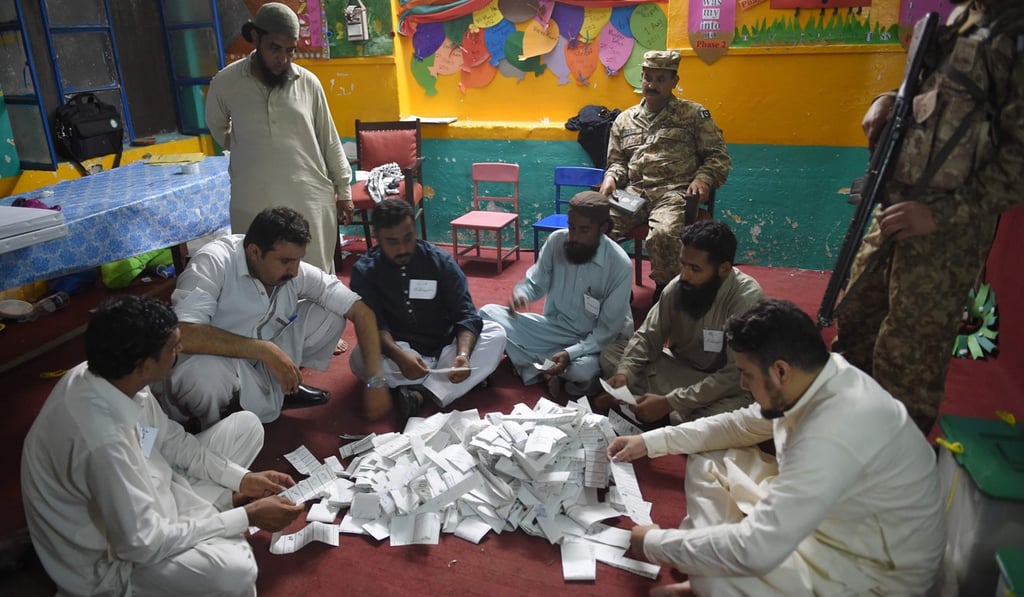
Pakistani election officials count ballot papers after polls closed at a polling station in Rawalpindi on July 25, the day vote-counting began for an election marred by a bloody suicide bombing and claims of military interference. Photo: AFP
Advertisement
Advertisement
Select Voice
Choose your listening speed
Get through articles 2x faster
1.25x
250 WPM
Slow
Average
Fast
1.25x