The View | Donald Trump’s warning against socialism is nonsense – just look at Hong Kong, Singapore and China
Socialism is a misleading label for the rhetoric emerging in the US. Democrats are just trying to rethink access to health care and education. Here, it may be instructive to consider freewheeling Hong Kong versus interventionist Singapore
In his State of the Union address, President Donald Trump warned the United States against the perils of socialism. Last year, the White House issued a report on the economic costs of socialism, which made no serious analysis, but consisted mostly of straw man arguments – intended for the domestic audience ahead of the 2020 presidential election, and directed at the likes of Bernie Sanders, who has more than 2 million online donors.
With the end of the cold war, capitalism had triumphed. One would be hard-pressed to find a believer in socialism in former socialist countries. The recent Trump-Kim summit in Hanoi was rich in symbolic significance. After experiencing first-hand the pains of a planned economy, the Vietnamese must be among capitalism’s most ardent supporters, perhaps more passionate than even the Chinese.
Yet, socialism is finding support in the long-time bastions of capitalism. In the developed world, the younger generation can hardly expect to better their parents’ standard of living. Millennials are struggling to afford homes. Among young Americans, positive views of capitalism are declining and socialism is seen more positively.
Advertisement
Still, the Democrats’ Green New Deal may be too ambitious, and is unlikely to progress far in the US legislative process. But the original New Deal was a watershed in US history. Against the backdrop of the Great Depression, the programme introduced social security benefits and set the stage for the US’ post-war economic boom and, arguably, the golden age of US capitalism. Today, faced with problems including unaffordable health care, crushing student debt and decaying infrastructure, Americans could use a new New Deal.
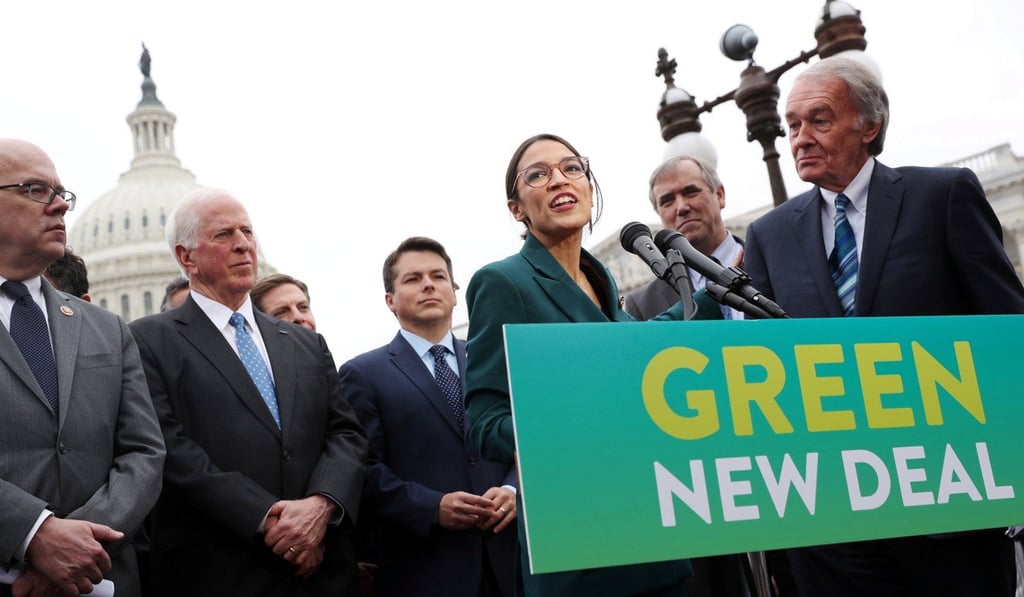
At a news conference in Washington on February 7, US Representative Alexandria Ocasio-Cortez (centre) and Senator Ed Markey (right) unveil a Green New Deal that proposes to eliminate US greenhouse gas emissions within a decade. Photo: Reuters
Advertisement
While the New Deal shifted the US towards government regulation of the economy, the rise of the New Right (and Ronald Reagan) switched the dial back to less government regulation. Under market fundamentalism, the economic divide has widened. Mega corporations and the super-rich are finding legal ways to pay lower taxes. Extra profits are shovelled into share buy-backs while workers are laid off. Americans are now reaping the bitter harvest of Reaganomics – the polarisation of society.