
Advertisement
Ukraine war: Opinion
Opinion
Maryam Baryalay

Opinion | As Ukraine crisis heats up Cold War rivalries, expect Afghanistan to be at the heart of new proxy wars

  • Asian powers must prevent both Russian and Western incursions into their weaker and conflict-prone neighbourhoods
  • Afghanistan’s geostrategic importance and conflict-prone environment means it will once again serve as the starting point for a superpower proxy war

Reading Time:3 minutes
Why you can trust SCMP
Taliban fighters ride atop a Humvee on their way to detain Afghans involved in a street fight in Kabul, Afghanistan, on September 21, 2021. Photo: AP
The invasion of Ukraine has essentially consolidated US-Russia antagonism on the global stage while upending the post-Cold-War security order in Europe. It has also initiated the militaristic rationale of the Cold War without providing the two ideological alternatives of organising politics, economies and societies that characterised that period.

In the face of this, it is critical to recognise that the Cold War’s proxy wars, or hot wars, will play out mercilessly and more viciously in conflict-prone regions of the Global South, while the North will use all means to extinguish these wars from its soil or try to turn them into frozen conflicts or prolonged asymmetric insurgencies.

In Asia, it is important that nations such as India, China, Pakistan, Iran, Saudi Arabia, Egypt, Turkey, and even Israel retain their balancing act and non-alignment posture and do not succumb to pressure from the West or Russia to choose sides.
Advertisement

The recent realpolitik-driven rapprochement of Turkish Prime Minister Recep Tayyip Erdogan towards Egypt, the United Arab Emirates and Israel; both Saudi Arabia and the UAE’s talks with Ukrainian President Volodymyr Zelensky and Russian President Vladimir Putin while avoiding US President Joe Biden; and Israel’s efforts to reach out to all sides, including Moscow, Berlin and Washington, all indicate diplomatic efforts to find a solution to this conflict but, more importantly, to avoid being sucked into a war that is being imposed on them.

This cooperation and diplomatic effort demonstrated by West Asian nations is also desperately needed between Beijing, New Delhi, Tehran and Islamabad.
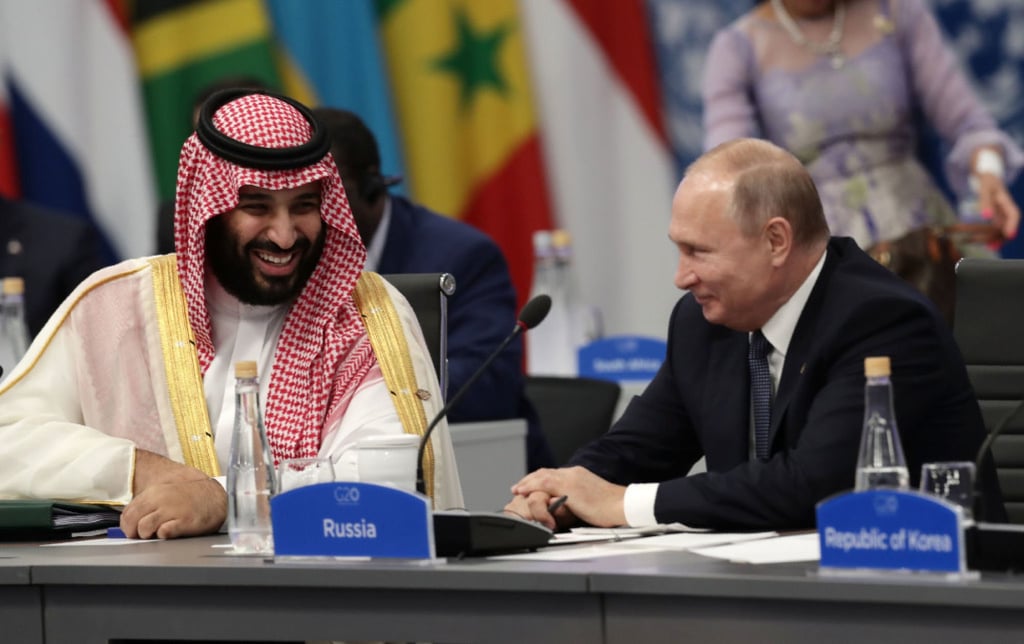
Saudi Arabia’s Crown Prince Mohammed bin Salman (left) and Russia’s President Vladimir Putin share a light moment at the G20 summit in Buenos Aires in 2018. Saudi Arabia’s leader recently reached out to both Putin and Ukraine’s president. Photo: AFP
Analysts have already pointed to the US-Russia rivalry in the Middle East as Russia’s military-to-military links with authoritarian regimes of the region – including the UAE, Saudi Arabia, Syria, Libya, Iran, and even Israel – have provided Moscow with legitimate leverage to threaten US security interests and project power into southern Europe.
Advertisement
Select Voice
Choose your listening speed
Get through articles 2x faster
1.25x
250 WPM
Slow
Average
Fast
1.25x