Chinese ceramics: everything you ever wanted to know in one show – including the reason for so many foreign knock-offs
Hong Kong exhibition underscores the flow of ideas about Chinese porcelain between East and West along the ‘maritime Silk Road’, from early counterfeits to Western commissions of tableware and even Christian figures

At a time when the inviolability of trade secrets is threatened by a global, collaborative model of business operation and frequent cyberattacks, it is fascinating to look back at a time when the Chinese managed to keep the secrets of making porcelain to themselves – for centuries.
It drove the Europeans crazy, and there were as many imitations as there are shanzhai (counterfeit) iPhones in Shenzhen’s Huaqiangbei market today. (A snappier title for a new exhibition in Hong Kong, “Objectifying China: Ming and Qing Dynasty Ceramics and Their Stylistic Influences Abroad”, might be “Shanzhai China”.)
The delightful exhibition at the University Museum and Art Gallery of the University of Hong Kong highlights little-known aspects of the history of ceramics, such as the first appearance of Chinese blue-and-whites during the Tang dynasty.
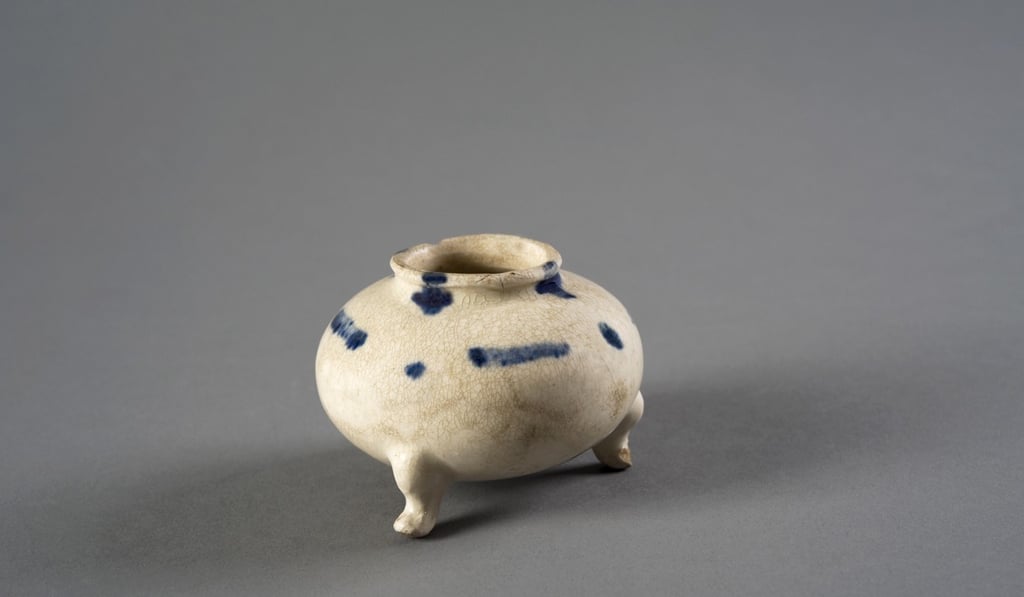
One of the exhibits is a 9th century water pot just over 7cm tall. Acquired by the museum in 1953, the comically rotund, short-legged vessel is decorated in blue cobalt imported from the Abbasid empire (in present-day Iraq).
Late Hong Kong tycoon’s Chinese abstract art project to continue
Back in 1953, the museum probably had doubts about the age of the pot, according to curator Ben Chiesa. The fact that blue-and-whites were made as early as that was only confirmed when shards were unearthed from Yangzhou in China’s Jiangsu province in 1975, and later, when three complete saucers were salvaged from the Belitung shipwreck of a 9th century Arabian dhow in Indonesian waters, he said. Those were early exports sold to the Middle East along the so-called Maritime Silk Road.