Review: HK Phil/Peter Ruzicka/Francois Leleux – not just the oboe that delighted
Composer conducts orchestra in performance of his oboe concerto, a Beethoven symphony and Strauss’ tone poem Till Eugenspiegel, the latter allowing HK Phil’s wind section a chance to shine

Opening a concert with a Beethoven symphony is unconventional programming, but his Symphony no. 4 in B flat major, described by Robert Schumann as a “slender Greek maiden between two Norse giants” – a reference to his fellow composer’s powerful third and fifth symphonies – was in keeping with this evening’s predominantly playful tone.
Demonstrating its growing flexibility, the Hong Kong Philharmonic Orchestra managed to maintain buoyancy despite conductor Peter Ruzicka’s rather staid tempi in the symphony’s first and third movements.
Had more been made of the mysterious Adagio introduction as it wistfully meanders through unrelated minor modes, and had it then been contrasted with a more sprightly Allegro Vivace, the goal of reaching B-flat major would have been achieved with greater effect.
The string playing was nevertheless top-notch and the woodwind soloists were superb in the wonderfully tranquil second movement Adagio. The scherzo-like Menuetto (another Allegro Vivace) again suffered a similar fate to the first movement, lacking enough impulse from Ruzicka to create an effective contrast to the trio’s boozy country dance. Fortunately, the infectiously energetic fourth movement Finale was more successfully paced, and allowed virtuosic brilliance to shine throughout the orchestra.
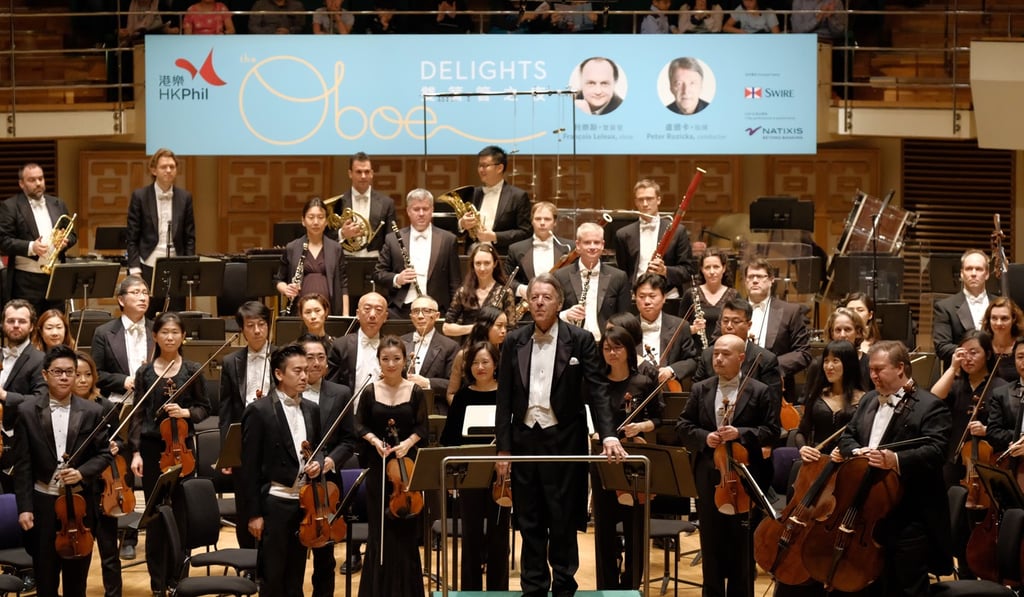
Ruzicka’s fascinating oboe concerto Aulodie (premiered in 2011) derives its name from the Aulos, a double-reeded ancient Greek instrument not unlike the modern oboe. The work consists of seven scenes which, as the composer describes them, have different densities, durations and instrumental balance but all begin with an identical musical shape and merge into each other.
Soloist François Leleux’s rich and captivating oboe sound made for tremendous colour variety (he switched between cor anglais and oboe for one scene) and his focus on interaction with an ensemble of strings, percussion, harp, piano and celesta was constant.