China’s private tutoring industry is booming despite economic slowdown
- Estimates of the size of annual revenues in the private education sector vary from 1.6 trillion yuan (US$238 billion) to 2.68 trillion yuan from Deloitte
- Online education market was valued at 251.7 billion yuan (US$37 billion) last year and will reach 380.7 billion yuan in 2020, consultancy firm says
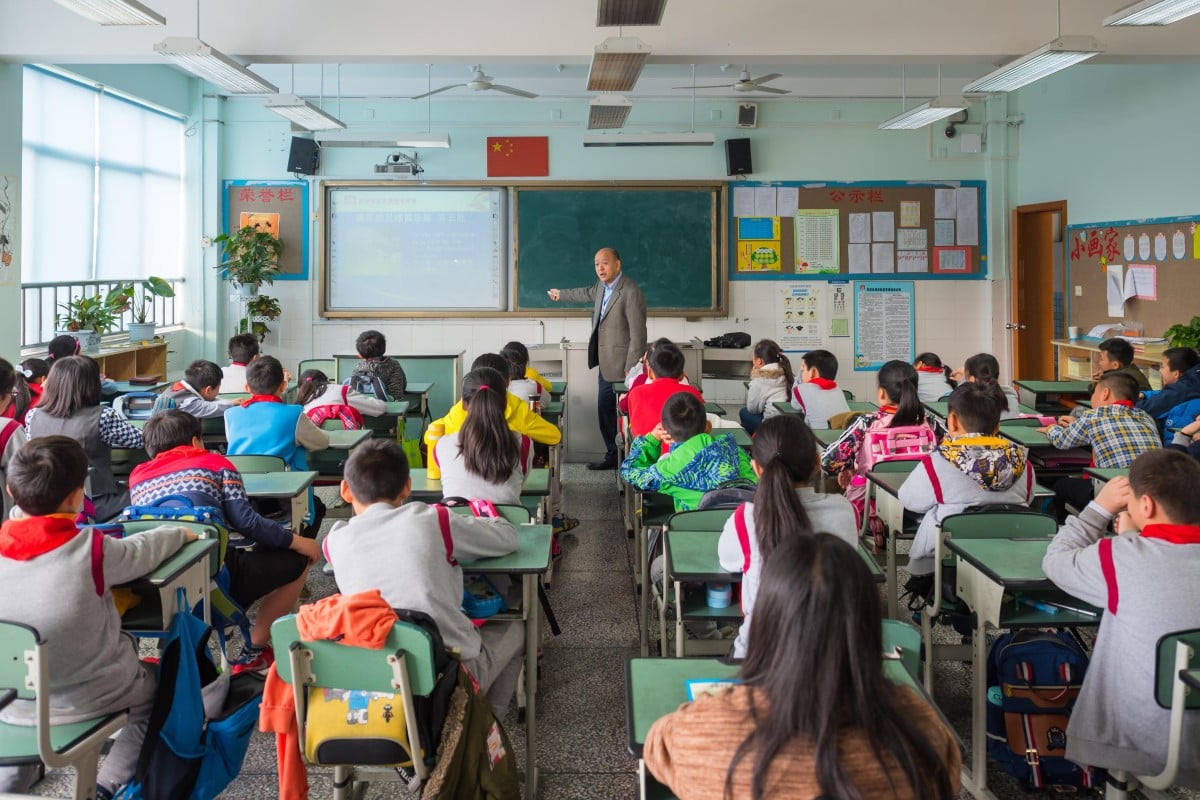
Amid China’s economic downturn, its booming education industry has become a bright spark in the gloom thanks to surging demand for after-school learning, resulting in an influx of investment capital.
Within the rapidly expanding private education sector, the fastest growth comes from after-school tutoring, such as private tutoring and English instruction classes as Chinese parents have no qualms about spending on such programmes to help their children.
“Parents can cut [other] discretionary spending, but they would never compromise on the education of their children,” said Anip Sharma, partner at management consultancy firm L.E.K. Consulting.
Such recession-proof spending on education is a component of the broader services industry that Beijing is counting on to offset the economic blow from the shrinking of traditional manufacturing industries compounded by the fallout from the US-China trade war.
Estimates of the size of annual revenues in the private education sector vary among industry experts, from L.E.K. Consulting’s 1.6 trillion yuan (US$238 billion) to audit and advisory firm Deloitte’s 2.68 trillion yuan. On the back of a compounded 10.8 per cent annual growth trajectory, the market could reach a value of as much as 5 trillion yuan (US$744 billion) by 2025, according to Deloitte.
That beats the pace at which the public education sector, run by the Ministry of Education, has grown. According to research firm Frost & Sullivan, citing data from the National Bureau of Statistics (NBS) and the education ministry, public education grew at a compound annual rate of 8.4 per cent between 2014 and 2017 to 4.19 trillion yuan (US$624 billion). Government spending on public education is about 4 per cent of the country’s gross domestic product.
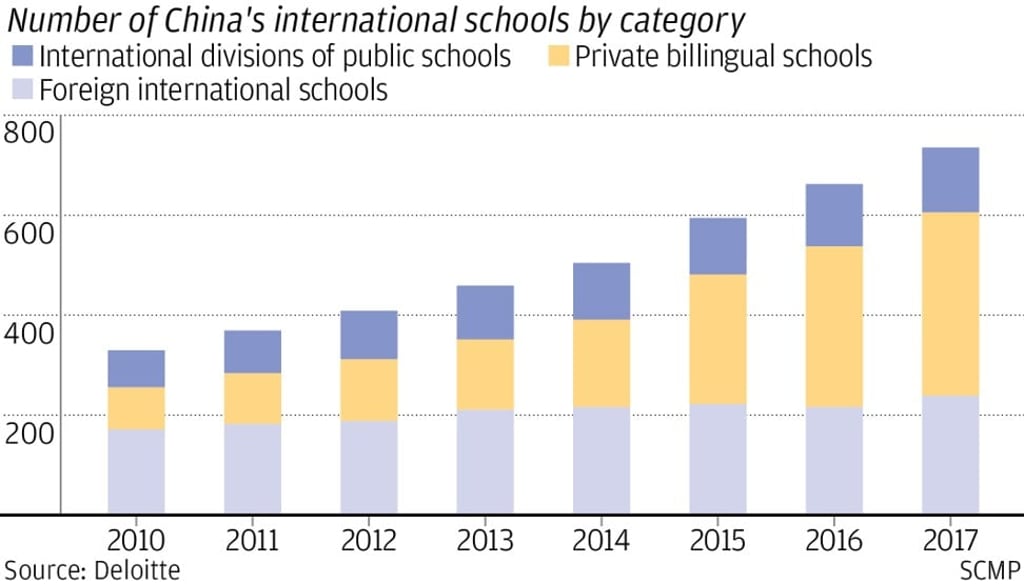
China opened the industry to private investors with the introduction of the “Outline for Education Reform and Development” in 1993, with numerous foreign operators entering the market over the following decade. As a result, the number of international and private schools in the country more than doubled to 734 between 2010 and 2017, according to Deloitte.
The private education sector has expanded in tandem with economic growth and affluence, underpinned by a devotion to child education that increasingly includes the adoption of diverse interests outside the traditional exam-oriented curriculum, or after-school tutoring, which has led to a 433 billion yuan (US$64 billion) market segment that market research company Frost & Sullivan has projected will increase to 500 billion yuan next year.