China struggling with slow progress on high-speed rail network expansion due to local financing problems
- Construction of new high-speed link between Zhengzhou in Henan province and Jinan in Shandong delayed due to funding issue
- Beijing’s policy moves to reduce debt and cut taxes are hampering local governments’ ability to fund new projects

Zong Zifa, a 67-year-old Chinese peasant who has worked the land his entire life, likes to stand at the eastern end of his village to check the progress of a new high-speed railway train station under construction. He and many of his fellow villagers hope that the station, on a plot of land where he used to tend to peach and walnut trees, will be the gateway for the otherwise sleepy village to connect with the country’s rapid development.
But “construction is slow … probably because of the funding shortage,” said Zong, while sitting under a tree playing with his grandson.
Zong’s village of Zongchanghu is on the eastern edge of city of Puyang in the province of Henan, around 500km south of Beijing. It is desperately in need of the economic development that could come with being connected to China’s high-speed railway network as its local economy is weakening having relied heavily upon an oil exploration and drilling industry that has almost run dry.
Last year, Puyang’s local economic growth slowed to 5.8 per cent, below the national average of 6.6 per cent, from 8.1 per cent in 2017 and 10.0 per cent as recently as 2014.
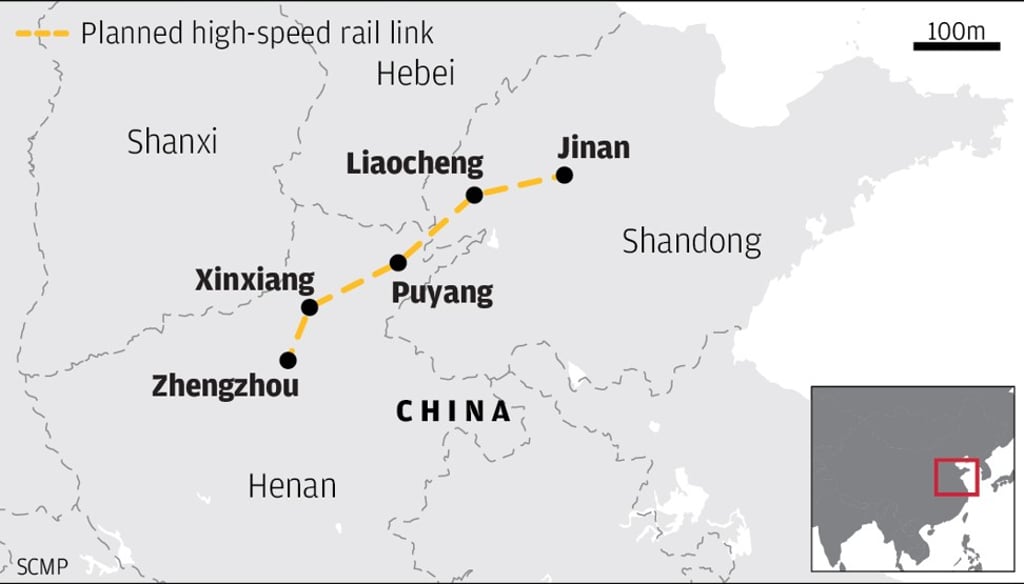
So, when the provincial governments of Henan and neighbouring Shandong, with Beijing’s blessing, in 2016 finally agreed to build the high-speed railway line running through Puyang, the city immediately jumped into action, setting up a task force comprising of the city’s top leaders to manage all the details of the construction project.