Chinese ghost town rumbling back to life as free-trade zone, but is the second time a charm?
- Some of the construction projects that were abandoned years ago have resumed, with renewed support from Beijing
- China is hoping free-trade designation makes once-abandoned Caofeidian attractive to manufacturers, in bid to boost the local economy and help curb the impact of a trade war with United States

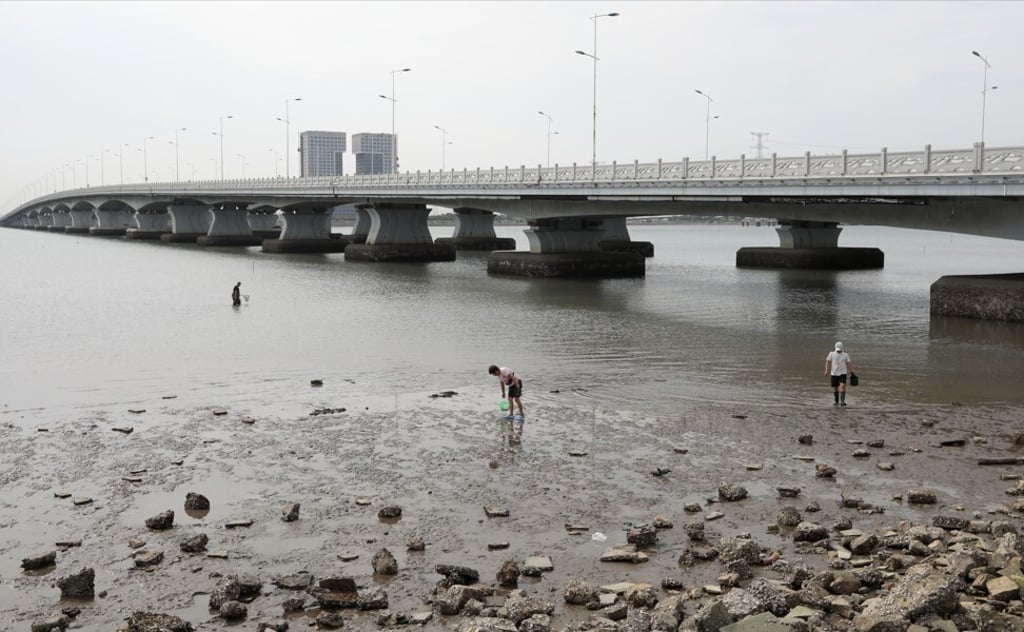
Along the coast and a stone’s throw from the headquarters of Caofeidian’s Economic and Technological Development Zone, in Hebei’s Tangshan city, small groups of people hurriedly collect cockles before the tide returns.
Around the government building, there are a series of Caofeidian Rural Commercial Bank advertisements hanging on street lights powered by solar and wind energy, enticing entrepreneurs to take out loans: “Achieve your dreams, start your business”, and “Loans for big firms of the future, serving small and medium-sized firms”.
Besides the huge government headquarters, the surrounding area features few people and vehicles, making Caofeidian’s economic zone look more like a fishing town than a business and tech district. Even though fishing is officially discouraged, the cockle collectors still took the risk.
“New businesses? I don’t know. I can’t see many businesses here. I only come here to catch some seafood,” said a cockle picker from Tangshan, her bicycle basket filled with her haul for the day. “It’s usually quiet here. I can even catch some crabs sometimes on the other side. I eat them, they are not for sale.”
Like many cities like in China, Caofeidian became a ghost town in 2014 after debt ballooned in the area, in this case following a failed attempt to diversify away from heavy industries. In 2016, when the South China Morning Post last visited Caofeidian, on the edge of China’s top steelmaking city of Tangshan, it was filled with unfinished buildings, as well as mostly locked up and abandoned hotels and commercial blocks.