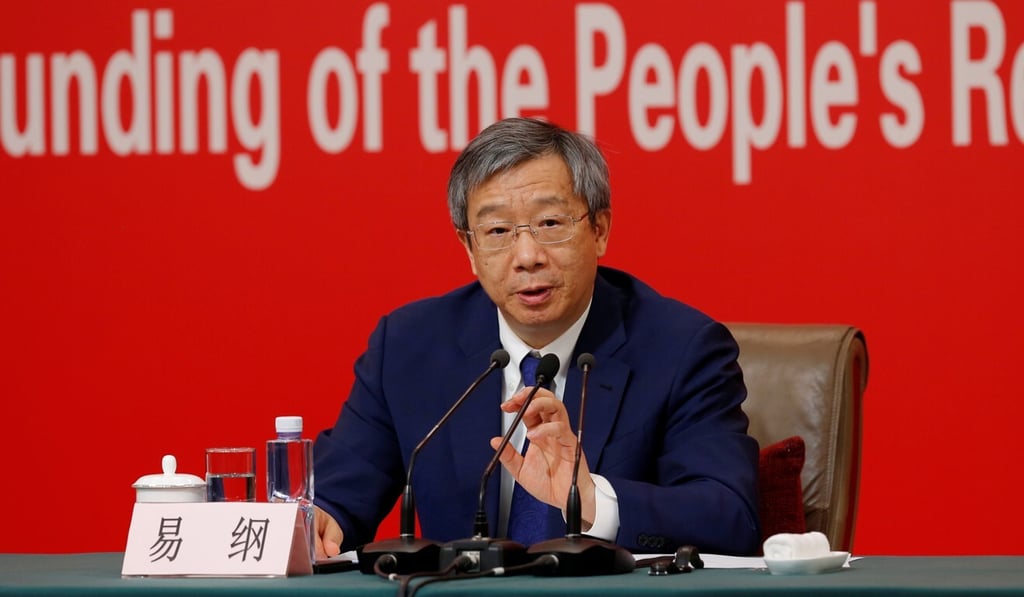
China won’t follow West by easing monetary policy, says central bank chief
- Yi Gang says People’s Bank of China will look to consumer price and exchange rate stability to help get economy back on track after Covid-19 pandemic
- Unlike US Federal Reserve, the bank has been reluctant to adopt policy of unlimited quantitative easing

China will not follow Western economies by undertaking a large-scale monetary loosening, but will instead look to consumer price stability and exchange rates to help the economy recover, the central bank governor has said.
“Implementing a normal monetary policy, i.e. a positive interest rate and a rising yield curve, is good to provide incentives for market entities and promote sustainable development of the economy and society,” Yi Gang wrote in an article published by China Finance magazine on Saturday.
“It will also be good to improve the competitiveness of yuan assets, and thus help us utilise both domestic and external markets.”
The world’s second largest economy has unlocked 9 trillion yuan (US$1.3 trillion) to fight the Covid-19 pandemic, stabilise the economy and help businesses and individuals.
But unlike the US Federal Reserve, which has started unlimited quantitative easing, the People’s Bank of China has been reluctant to inject more liquidity and actually slowed the pace of credit supply after its initial efforts to kick-start the economy.
“We need to maintain reasonable liquidity, money supply and aggregated financing, but must say no to a flood of money at the same time. Instead, we should target growth near potential productivity and avoid economic fluctuations,” Yi wrote.
China’s benchmark one-year deposit rate was kept unchanged at 1.5 per cent, while the benchmark one-year loan prime rate (LPR) has only fallen by 1.3 percentage points so far this year, guided by the central bank’s policy rate cuts.