Rethinking the future of ESG in Asia
- ESG (Environmental, Social, and corporate Governance) is a fundamental component to many companies in the modern-day, and for a good reason
- With the right mindset and skill set, businesses across Asia and around the world can reach their ESG goals and contribute to a more sustainable future
Sustainability is now a mainstream agenda, and it is more clear than ever that “the health of the planet, humans, businesses, and economies are interdependent and interconnected,” says Esther An, Chief Sustainability Officer at City Developments Limited. ESG (Environmental, Social, and corporate Governance) is a fundamental component to many companies in the modern-day, and for a good reason.
![(Top left to bottom) [Moderator] Eric Ng, Correspondent at South China Morning Post, Ong Pang Yen, Executive Director of the Sunway Group, and Esther An, Chief Sustainability Officer at City Developments Limited discusses on the adoption of ESG practices into the corporate world and challenges faced during the process.](https://img.i-scmp.com/cdn-cgi/image/fit=contain,width=1024,format=auto/sites/default/files/styles/660x385/public/d8/images/2021/09/15/rethinking_future.png?itok=qB1lPvGy "(Top left to bottom) [Moderator] Eric Ng, Correspondent at South China Morning Post, Ong Pang Yen, Executive Director of the Sunway Group, and Esther An, Chief Sustainability Officer at City Developments Limited discusses on the adoption of ESG practices into the corporate world and challenges faced during the process.")
ESG as a Business Philosophy
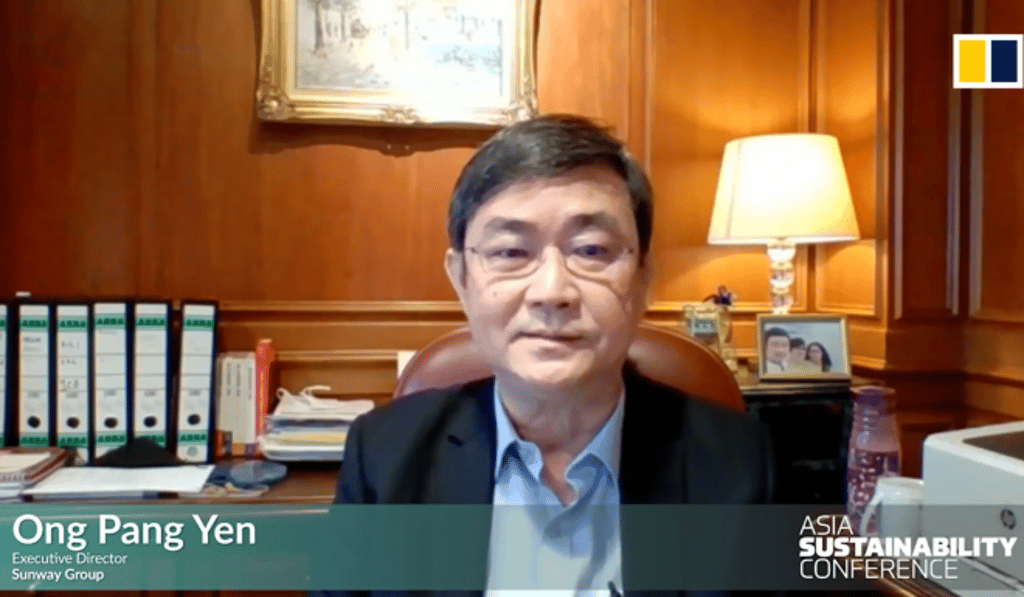
“Business is no longer just about business … we need to add purpose, and we need to add sustainability to the triple bottom line: planet, people, and profit,” remarks An. Ong Pang Yen, Executive Director of the Sunway Group, goes on to say ESG should not be seen “as a mere disclosure framework with numbers,” but as a “culture, business philosophy, and value system.” Thankfully, investors seem to share the panelists’ opinions, as many of them are using ESG metrics to make their investment decisions.
According to An, the strategy behind successful ESG can be separated into four pillars: integration, innovation & adaptation, investment, and impact. Urgent action and integration of better business models and technology is needed; clever innovations and quick adaptation to new environmental and social situations are needed; funds are needed to fuel sustainability projects and support businesses’ ESG goals; finally, businesses must have a reliable way to measure the impact certain innovations have on their goals.
While these pillars are not easy for businesses to construct, it must be done for the sake of sustainability. As Yen said, “sustainability and survival are two sides of the same coin … ESG is actually a survival tool.” When businesses and their stakeholders are encouraged to think of ESG as a tool essential to their survival rather than an idealistic conversation topic, they can better understand the risk that they face.
The Future of ESG in Business
The only answer to issues such as climate change and social injustice is to create effective solutions. Fortunately, investors and stakeholders in many businesses are on the same page. An shares how “from 2017 onward, the number one ESG issue has been innovation,” and investors are aligned with this goal. The pandemic also contributed to the growing interest in ESG, and An notes “in 2020, there [was] drastic growth of ESG investment.”
![Esther An, Chief Sustainability Officer at City Developments Limited notes how “in 2020, there [was] drastic growth of ESG investment.”](https://img.i-scmp.com/cdn-cgi/image/fit=contain,width=1024,format=auto/sites/default/files/styles/660x385/public/d8/images/2021/09/15/esther_an.png?itok=ubQAif7A "Esther An, Chief Sustainability Officer at City Developments Limited notes how “in 2020, there [was] drastic growth of ESG investment.”")