The women bikers making inroads against male taboos in Pakistan
WATCH: Riders in Lahore find independence and a safe means of transport to and from work in a conservative Muslim society where women are increasingly pushing the boundaries set for them by men

On the crowded roads of the teeming Pakistani city of Lahore, Tayyaba Tariq zips through the rowdy traffic on her brand new motorcycle.
SEE ALSO: Harassed, cornered, threatened with death: life as a woman driver in Afghanistan
In jeans and a bright jacket, with a white helmet clasped over her hair, the 22-year-old student is part of a new wave of female motorists in Pakistan who are pushing the boundaries set for them by men.
SEE ALSO: Karachi lets its hair down – this time, behind closed doors
The idea of women straddling motorcycles, clambering into the cabs of Pakistan’s iconic heavy trucks, or driving rickshaws for money is still taboo in the deeply conservative Muslim country of some 200 million, where gender discrimination is routine. But recently there has been a slew of campaigns by women for greater access to public spaces to which they are often denied, such as roadside restaurants – and the roads themselves.
They think that a girl can’t ride and will be frightened... But I have a message for boys. They should not consider girls inferior
The importance of the issue is underscored by the fact that three quarters of Pakistani women do not participate in the labour market, mainly due to a lack of safe transport, according to a study by the International Labour Organisation.
“If girls learn to ride a motorcycle, they can move freely, come and go independently,” says Tariq, who rides 25km to the border with India and back every day for her job as a customs officer on her motorbike, a far more affordable mode of transport than a car.
WATCH: Women hit the road in Pakistan
Sajjad Mehdi, a traffic police official in Lahore, says he had trained nearly 150 women to ride a motorbike recently. “But there are many women who learned to ride a bike on their own,” he adds.
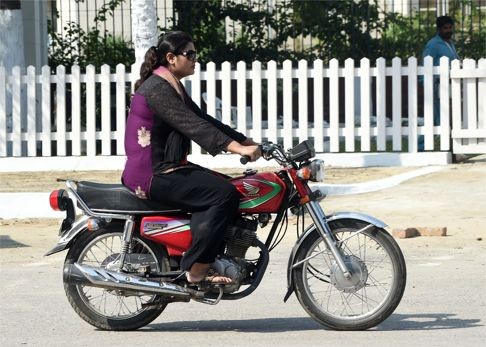
The campaign saw 150 women, who had completed a police-run motorbike training programme, ride through the streets of Lahore on Sunday in a rally attended by diplomats and human rights lawyers, as it was revealed that 1,000 subsidised pink scooters would be given to working women and students under the scheme.
Tariq may be able to avoid men harassing her by nipping through traffic, but women using Lahore’s many rickshaws are often not so fortunate: trapped by necessity in a tiny vehicle with a male driver, getting from A to B can often be a hassle.
For Zar Aslam, the solution was obvious: women-only rickshaws, driven by women for women, empowering both passengers and enterprising women who need a source of income.