Three women artists make statements about killings
A London exhibition shows women are more intuitive in their artistic response to violent crimes

It soon became clear to Sejla Kameric how big her work, Ab Uno Disce Omnes (From One, Learn All), would become. Commissioned by the Wellcome Collection in London for its new exhibition "Forensics: The Anatomy of Crime", the Bosnian artist - whose previous work tried to make sense of the war that started when she was a teenager and that killed her father - took on something huge.
She describes it as a monument, but one made of data, not stone, and just as permanent. "I found out how the information about what happened is becoming lost," she says.
"Because of the political vacuum, even the scientific facts are being erased and the one thing which is very much needed is to have the collective narrative of what actually happened. The lack of, for example, a list of missing persons 20 years after the war is horrific, or the means of how to get the information on the location of mass graves or execution sites or concentration camps."
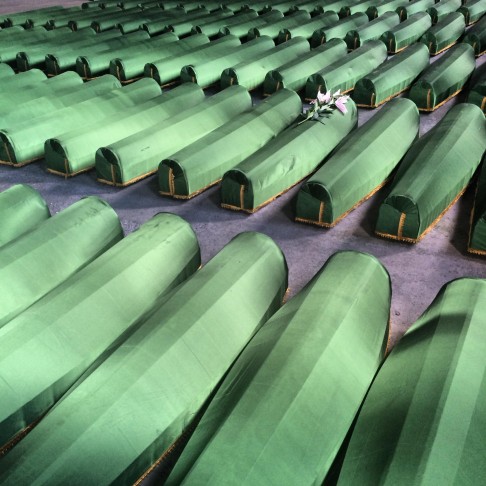
More than 30,000 people are thought to have gone missing during the conflict, and about 9,000 are still unaccounted for. Kameric's work, a mortuary fridge with a screen that flashes up random images from her search - about 30,000 photographs, documents, records, satellite images and hours of video - provokes both a feeling of her unfolding mission and the vast scale of the crimes.
"I knew we had to collect as much as possible," says Kameric, who worked with a team of researchers and spent months visiting families, mortuaries, and sites of mass graves. "When you think about 34,000 people missing, it's just a number, but if you start counting it you understand - each single person had their own lives, families. One big wish for me is to show through this work how we are all connected, how each of us is just one knot in a huge web."