Hong Kong Arts Centre anniversary show is a love letter to Wan Chai – its home for 40 years
‘Wan Chai Grammatica: Past, Present, Future Tense’ shows the eclectic Hong Kong district through the eyes of 18 artists and one artist duo – but you don’t have to be familiar with the area to appreciate it

The Hong Kong Arts Centre is celebrating its 40th anniversary with an art exhibition that is a love letter to Wan Chai, its home.
The exhibition also serves as a broader reminder of why people develop such affection for the places in which they live, even when those places are as curmudgeonly, ill-mannered and physically hostile as Hong Kong.
“Wan Chai Grammatica: Past, Present, Future Tense” features mostly new works from 18 artists and one artist duo from various generations and backgrounds.
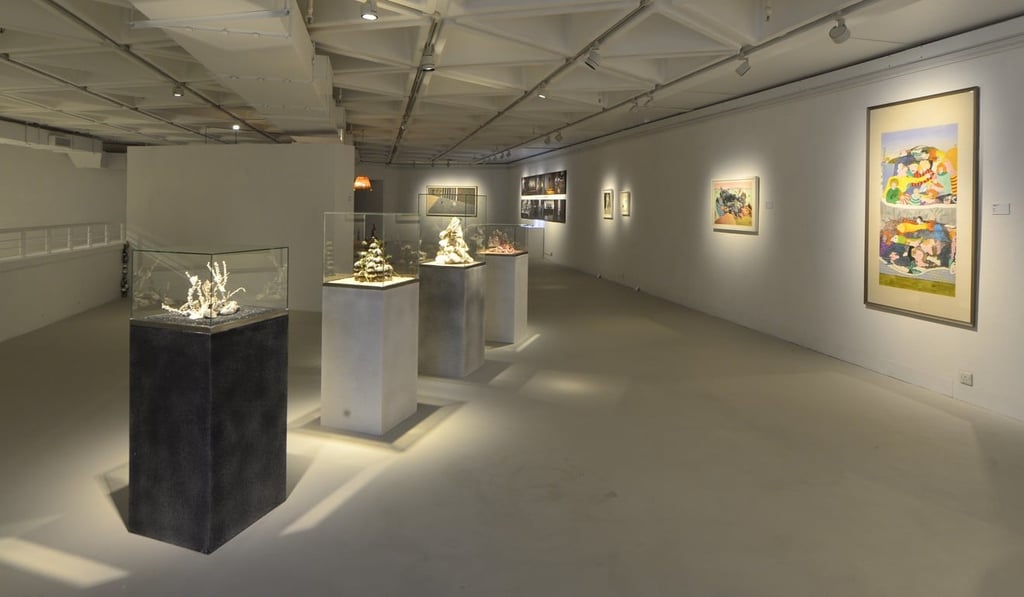
Some of those artists have looked to history for inspiration. Artist duo Laurent Gutierrez and Valerie Portefaix, also known as MAP Office, used as a starting point paintings by the late Luis Chan, who lived above a topless bar on Lockhart Road. Chan often painted Hong Kong as a strange island with anthropomorphic features and colourful, eccentric inhabitants. For their piece, the duo – residents in Hong Kong since 1996 – stacked fish tanks like high rises and constructed several dioramas out of shells and figurines that as just as fantastical as Chan’s creations.
Ho Sin-tung’s One Thousand and One Moons is based on her research into the mission and orphanage set up by the Sisters of St Paul de Chartres in Wan Chai in the mid-19th century. The Catholic nuns rescued a thousand girls from the streets – many of whom had been abandoned or sold into the sex trade – for a silver dollar each. Ho’s installation – which includes paintings, personal objects and a floor scattered with dollar coins – is the only reference to Wan Chai’s famous red light district in the exhibition and, fortunately, comes without any cliched Suzie Wong imagery.