Review | Graphic novel biography of Korean wartime sex slave of Japanese army, Grass, doesn’t pull its punches
- Sent to work at 15, abducted to a mud hut in China to serve as a sex slave, abandoned by her first husband, unloved by her second, life was harsh for Lee Ok-sun
- Keum Suk Gendry-Kim’s book, based on interviews with Lee at a nursing home, is not an easy read but depicts with sensitivity the twists and turns of her journey
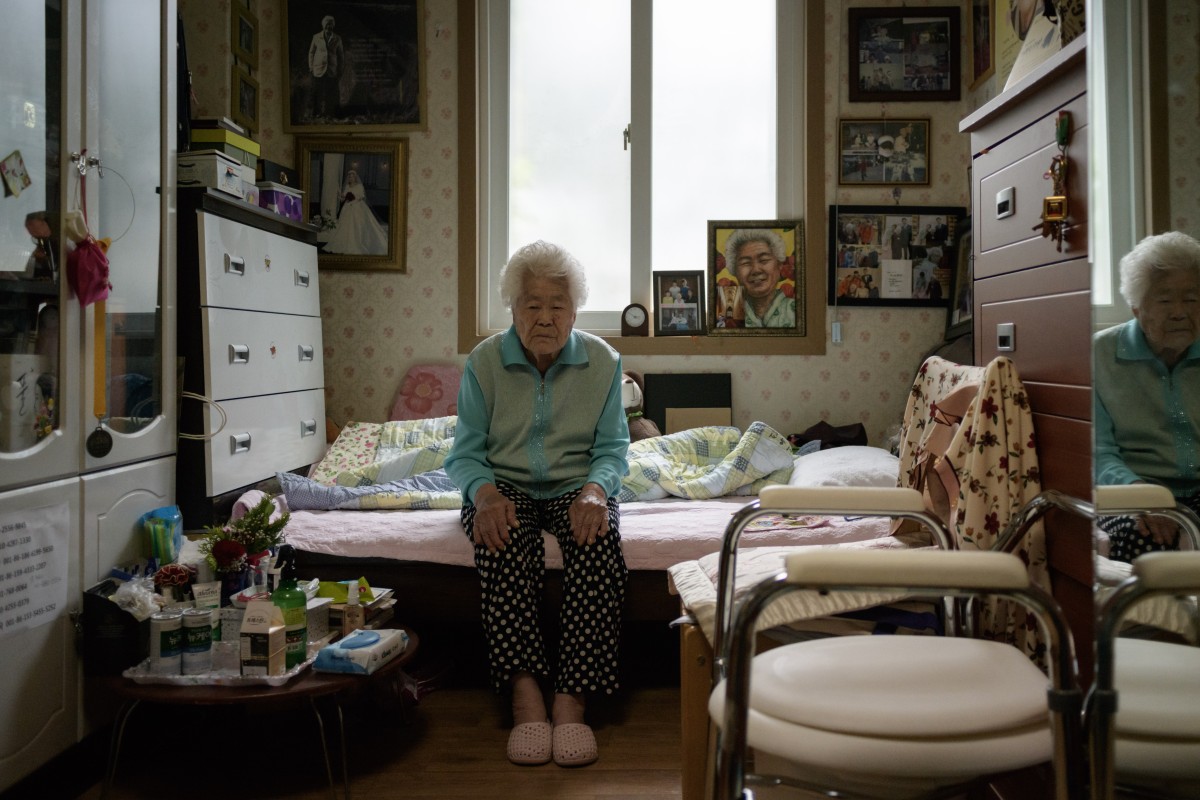
Grass, by Keum Suk Gendry-Kim, pub. Drawn and Quarterly, 4.5/5 stars
The opening pages of Grass, a graphic novel, introduce a girl. Her expression, distilled by a few sharp ink strokes, is full of pain, sorrow and uncertainty. Surrounding her on the blank page is an unmoving whiteness, with no sky or ground to anchor her to reality. Her eyes are downcast, her body cloaked against an invisible frost.
This is the real-life protagonist of Grass, Lee Ok-sun. Born in Busan, South Korea, Lee was one of a still undetermined multitude of girls and young women forced into sexual slavery across East Asia by Japanese soldiers during the second world war.
Author Keum Suk Gendry-Kim shows Lee as an elderly woman leaving China, where she has endured one of the most traumatic chapters of her life, spending decades in a loveless, abusive marriage, and a place to which she feels inextricably bound. As she boards the plane, Lee expresses hope and relief at returning to her hometown for the first time since she left, and soon we are transported into her cherished childhood memories, as told to Gendry-Kim.
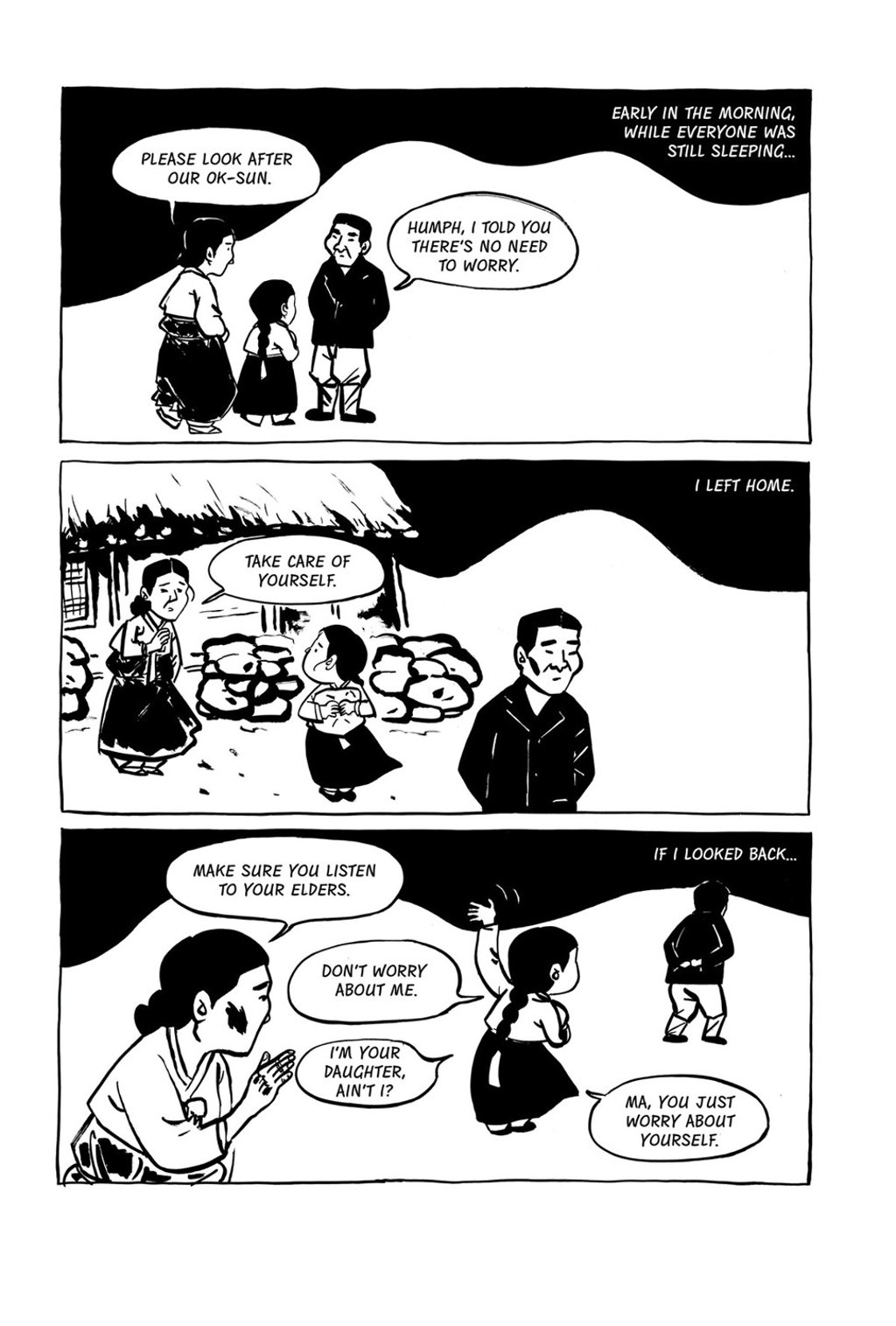
The first few chapters of Lee’s young life are illustrated in bright, sharp tenor: the lines are crisp, delineating a glossy braid down her back, a ripe persimmon, her siblings’ faces, or the bark of a tree in spring. Throughout, we see the grass of the book’s title – not just the stalks themselves, rolling in waves, but also shrubbery, undergrowth, looming canopies and craggy mountains. Using this grass, which sweeps across grids and pages, as a metaphor, Gendry-Kim sensitively navigates the twists and turns in Lee’s story.
Lee’s childhood ends abruptly after her parents send her to a noodle shop in Busan to work for a childless couple at age 15. From there, her story has no resolution. She finds work at a brothel, then is abducted and moved to Yanjin, China, where she is locked in a mud hut with several other girls, beaten, and raped repeatedly – dozens of times a day – by Japanese soldiers.