ReviewTeacher of Robert Rauschenberg and Richard Serra, Josef Albers’ painted squares at David Zwirner Hong Kong present a compelling mystery
- What is the nature of colours? What do they do to us? How do our eyes react to them? These appear to be questions Josef Albers sought to answer in his squares
- He painted over 1,000 versions of Homage to the Square as if he wanted to finish a catalogue of colours. David Zwirner Hong Kong has a representative selection

Josef Albers’ squares only begin to make sense when you see them in person. The formulaic progressions of three or four of the shapes may seem flat, cold and mechanical in reproductions. But up close, they flicker and come alive.
Unevenness is created by the scraping of paint with a small palette knife across the primed surface of a compressed wood board, the varying thickness of the paint allowing specks of the white background to come through. Sometimes the edges of the squares waver. The artist was not aiming for perfection. Instead, he was demonstrating.
The “Square” in the series title evokes Kazimir Malevich’s 1915 Black Square, that “hour zero” reset of modern art that opened the way for the rejection of narratives and mimesis in 20th-century art. But the concentric shapes are really just the support; the paintings were to pay homage to the nature of colours: what they do to us and how they react to each other in our eyes.
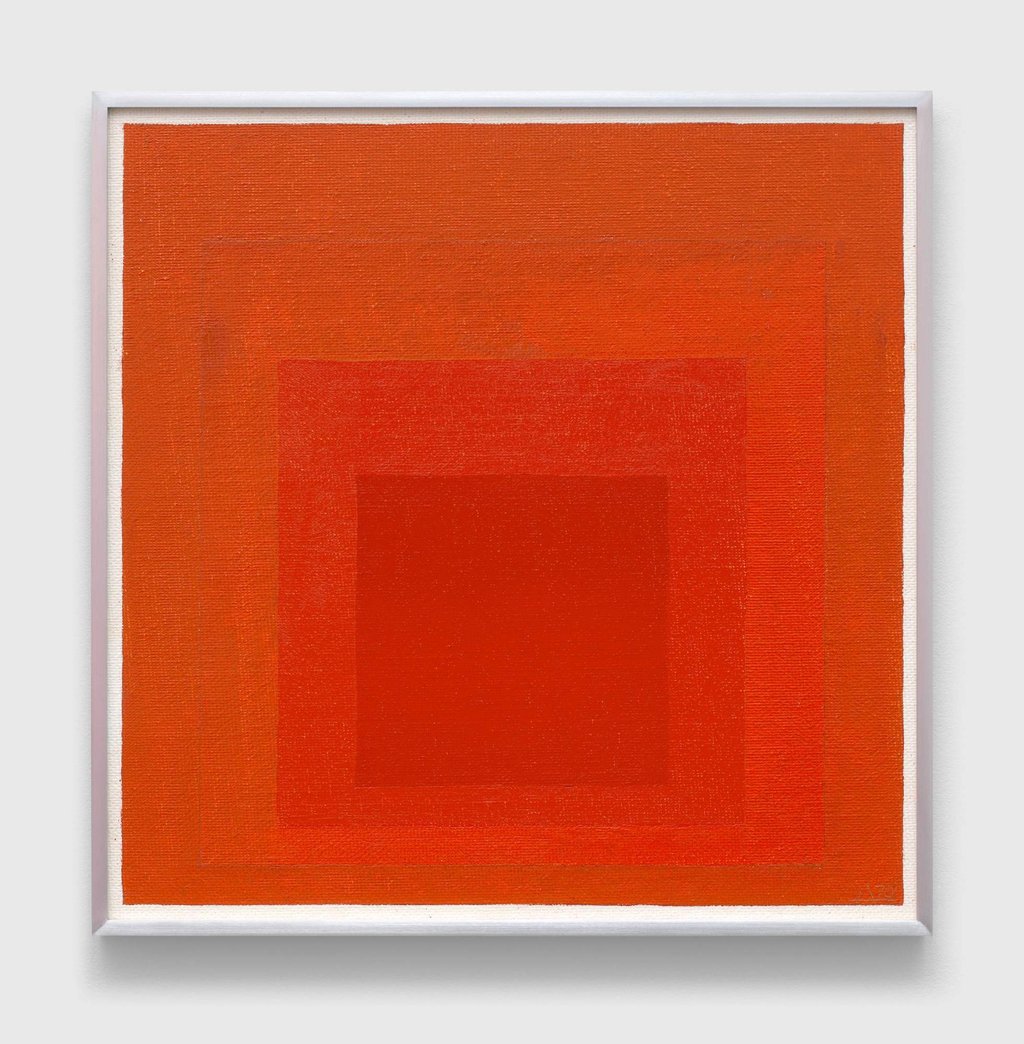
At the David Zwirner gallery in Hong Kong, a large selection of Albers’ works is showing until March 5. The gallery website has a video in which Albers explains that he would first use a pencil and ruler to draw three or four precise squares on a Masonite panel. Then he filled each section with a different colour squeezed straight out of the paint tube with a small palette knife, bit by bit so that he could keep to the edges fairly accurately.