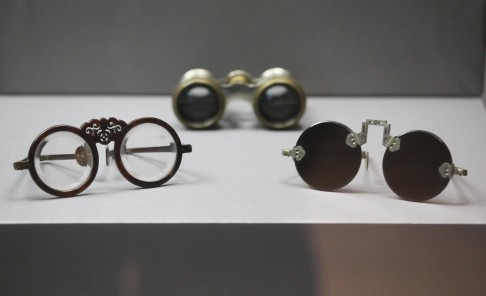
Qing dynasty scientific instruments on show in Hong Kong
Western inventions in fields such as astronomy, mathematics and medicine, loaned by Beijing's Palace Museum, among those on display in interactive Science Museum exhibition

At first glance, the painting bathed in soft golden light hanging in the centre of the gallery at the Hong Kong Science Museum appears to be just another depiction of the Forbidden City. But closer examination reveals its true importance, making it an integral piece of the museum's new exhibition, "Western Scientific Instruments in the Qing Court".
Commissioned by Emperor Qianlong (1735-1796), the painting illustrates foreign envoys bringing tributes to the Qing court. Distinctly different from the Chinese men detailed in the painting, the foreigners, hailing from places such as Europe and Japan, are identified by their dress and by banners declaring where they come from. This image represents the exhibit's raison d'être: to tell the story of the bond between East and West, fostered by a mutual interest in scientific advancement and strengthened by a merging of cultures.
As early as the Marco Polo era (13th-14th century), foreign missionaries flocked to China to spread Western beliefs and ideals, which included thoughts about science and medicine. They brought with them samples of European technology, some of which are displayed in this exhibition and span a variety of categories such as astronomy, mathematics, medicine, weaponry and horology.
Emperor Kangxi (1662-1722) encouraged and fostered the exchange of ideas between China and Europe as he took a personal interest in the instruments that were presented to the Qing court, says the exhibit's curator, Paulina Chan Shuk-man.
"In the past, China was very conservative," she says. "Europeans brought innovative ideas and more liberal thinking into the country."