-
Advertisement
Art
LifestyleArts

Jeff Koons’ Split-Rocker sculpture in LA to be made of more than 50,000 flowers and plants

Half rocking horse head, half dinosaur head, Jeff Koons’ Split-Rocker is set to bloom at the Los Angeles County Museum of Art

3-MIN READ3-MIN
Listen
Jeff Koons Split-Rocker at the Los Angeles County Museum of Art will be covered with 50,000 flowering plants and made to look like a child’s toy. Photo: AFP
Tribune News Service

Jeff Koons stood on top of a construction lift and planted a silvery-grey succulent on the nose of his topiary sculpture Split-Rocker at the Los Angeles County Museum of Art (Lacma) in the US state of California.

“I’m so excited, Los Angeles is feeling like home!” the 70-year-old artist exclaimed from his perch halfway up his 37-foot-tall (11-metre-tall) sculpture while workers and various Lacma employees cheered and clapped below.

“It is home!” Lacma director and chief executive Michael Govan yelled up at the beaming Koons.

Advertisement

Lacma announced the sculpture’s acquisition in June, noting that it would anchor the east side of the campus at the David Geffen Galleries opening in April 2026. Work soon began on erecting the sculpture, which is made of 1,800 linear feet of steel tubing and 500 planter boxes.
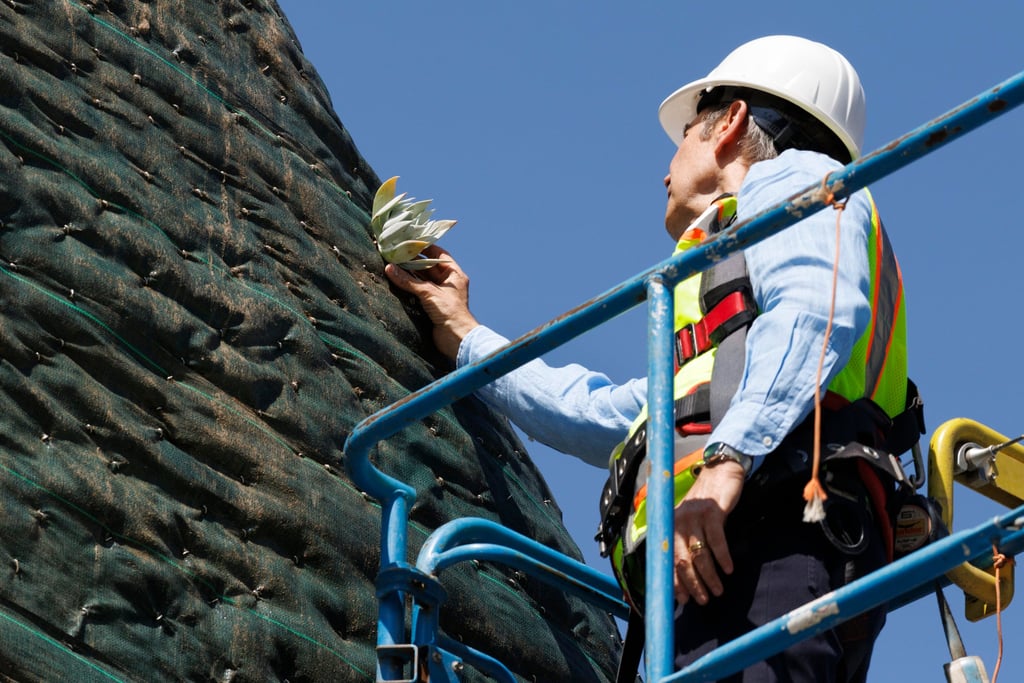
Koons flew in from New York to perform the ceremonial first planting of what will be more than 50,000 flowering perennials and succulents in 110lbs (50kg) of soil packed into the sculpture, held in place with wire mesh and a dark green landscape fabric.
Jeff Koons plants a ceremonial succulent on his latest Split-Rocker, the first plant in the installation that will feature 50,000 plants and flowers. Photo: Los Angeles Times via Getty Images

Koons worked for more than a year with a team of landscape architects from LRM Landscape Architecture, including Kathy Wishard, who noted the plants are sustainable, native to California and should flower almost year-round – creating their own ecosystem with roots that will further strengthen the creation.

Advertisement
Select Voice
Select Speed
1.00x