How US painter became Hong Kong Artists Association’s first non-Chinese member
Vermont native Nissa Kauppila talks about fusing Eastern and Western painting styles on discarded materials following her recent induction

In January, the American-born artist Nissa Kauppila was accepted into the Hong Kong Artists Association, a professional organisation founded in 2014 to promote traditional Chinese culture, becoming the first non-ethnic-Chinese practitioner admitted into its midst.
The association chairman, Lam Tianxing, an ink painter, has high praise for the 43-year-old Lantau Island resident.
“When I first saw her work, I was particularly impressed,” he says. “She possesses exquisite painting skills while conveying a uniquely Eastern artistic atmosphere – ethereal and full of vitality.”
What makes her work distinctive is not that she has simply adopted a Chinese aesthetic, but that she has fused it with Western techniques into a single, cohesive vision.
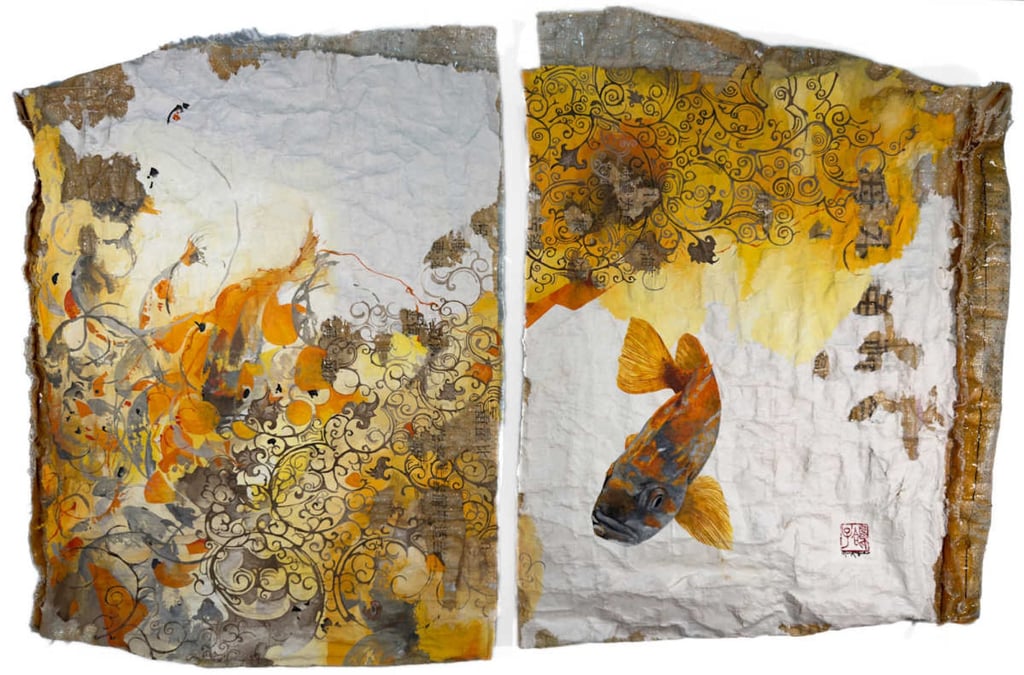
Her birds and butterflies are not mere poetic abstractions; they are biologically accurate specimens, capturing the individual barbs of a feather or the articulated joints of a leg with scientific precision. The result is a body of work that exists in the liminal space between hemispheres.