Coronavirus: should I make my own mask? How home-made ones may help stop Covid-19 spread
- Some experts say home-made masks could be useful as a barrier to stop those infected with the coronavirus from contaminating others
- ‘It’s not perfect, but that’s much better than nothing,’ one researcher says, although others claim it doesn’t eliminate risk

Is a home-made mask better than nothing at all? With an unknown number of asymptomatic virus carriers, some experts are advising people to fashion their own face coverings to prevent them from spreading the disease.
Even US President Donald Trump weighed in on the matter in a White House briefing. “It’s not a bad idea, at least for a period of time to cover your face when going out in public,” he said. “You can use a scarf, a lot of people have scarves … a scarf would be very good. My feeling is if people want to do it there’s certainly no harm to it. I would say do it. Use a scarf if you want rather than going out and getting a mask.”
As health workers across the world struggle to get protective equipment and stocks dwindle, health organisations have stressed that there is little scientific evidence to show that masks are effective at preventing healthy people catching Covid-19.
But some experts say they could be useful as a barrier to stop those infected – particularly those without symptoms – from contaminating others through the tiny respiratory droplets emitted when they cough, sneeze, talk or even breathe.
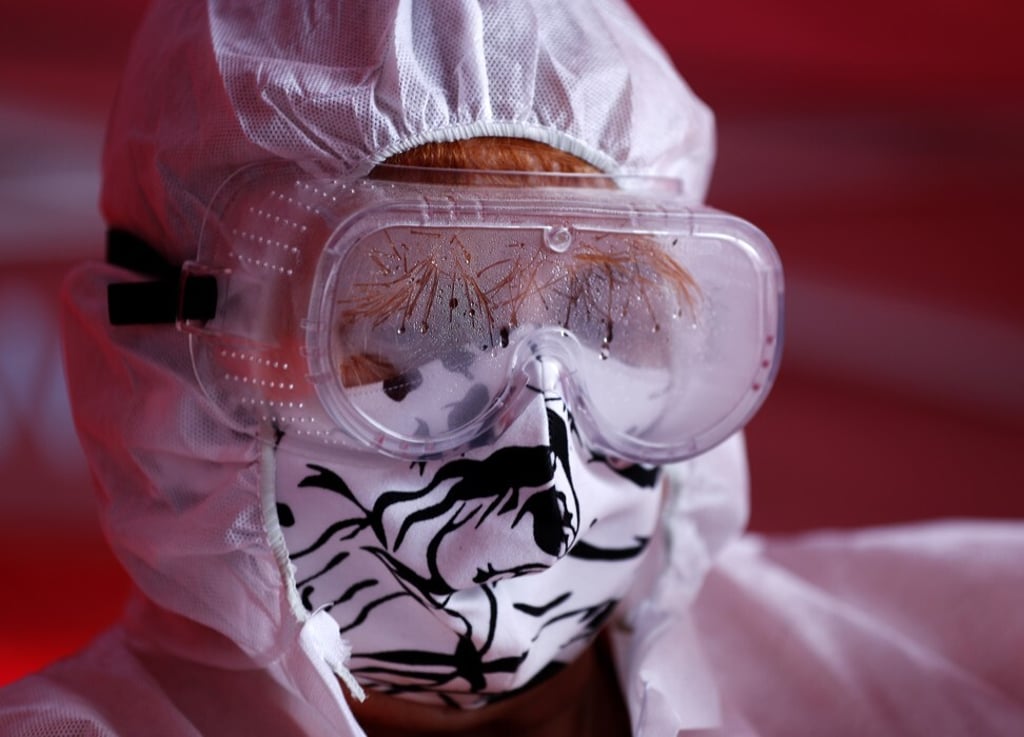
“It only works if everyone wears [them], and if everyone does, you only need a very basic mask, because a piece of tissue can block it,” said KK Cheng, director of the Institute of Applied Health Research at Britain’s Birmingham University. “It’s not perfect, but that’s much better than nothing.”