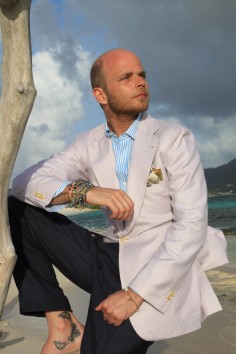
Luca Rubinacci, Neapolitan tailor and professional dandy, on his colourful life
The boss of Rubinacci talks about Neapolitan suiting and the Pitti Uomo trade show.
"I'm not interested in fashion, in design, I'm interested in beauty. All things that people make that are beautiful and well made. When it comes to clothes, how it looks is most important and second is how to wear it. These are two different things. People see things differently, but just because a pair of shoes are not for you, you cannot say 'I don't like them'. You can say it's not for me. Today people are too narrow minded, they don't have the personality, the bravery to mess with fashion. On the other side, you have guys wearing a red jacket and white trousers without knowing why they are wearing it, they just follow.
The Neapolitan style is a lifestyle concept, it's a way of dressing simply. We dress with comfort in mind, we don't dress too baggy or too tight, we dress more comfortably than the British. My grandfather was the inventor of the Neapolitan way of cutting the suit, so suits without padding, without the canvas. We took the British style and took away the padding on the shoulders. It was the 1930s and guys wanted something to wear on holidays, with a more relaxed fit, and that's how the Neapolitan cut was created.
Many other tailors from Naples followed the style and it became famous. Today, at Rubinacci we count 40 tailors in our house and we are the biggest tailoring company in Europe. We sell 1,000 suits per year, all bespoke. That is insane for people in the business.
I trained in Savile Row. When I was 20, I didn't want to study and I told my father: 'After studying for five years, I don't know anything, I don't know the business'. I wanted to learn our business but my father didn't want me to bother him, so he said 'OK, I'll send you to London to learn with the best tailor in Savile Row'. I trained at Kilgour, French & Stanbury, on the first day I started working at Kilgour, all the English tailors started making fun of my father's suits, telling me how they were wrong, so I called him and said I wanted to come home, he asked why, and I said he made suits the wrong way. He replied that he was happy as they had made me learn something after only two hours of working there and that I was likely to learn more. The next day I knocked on the door of head tailor of Kilgour and demanded that they teach me the English way.