Fabric that can display messages developed by Chinese scientists
- Scientists from Shanghai’s Fudan University working on clothing with electronic functions that is foldable and washable recently made a breakthrough
- They examined the structure of textiles, and developed luminescent and conductive yarns that, woven together with cotton, light up where they intersect

At first glance, the fabric looks like a pretty, if not especially original scarf, with turquoise, blue and orange stripes in an open weave. But this fabric can communicate. It’s wearable, foldable and washable, but it’s also a fully functioning display – capable of flashing messages or images, or even being used with a keyboard.
The fabric, described in a study in the journal Nature, is the work of a team led by Huisheng Peng, a professor in the department of macromolecular engineering at Shanghai’s Fudan University.
He believes it could revolutionise communication and “help individuals with voice, speech or language difficulties to express themselves to others”. “We hope that woven-fibre materials will shape next-generation electronics by changing the way we interact with electronic devices,” he said.
Wearable electronics have advanced significantly in recent years, and clothing incorporating electronic functions including super-thin displays is already available. Another study published this week, for example, describes a wearable microgrid powered by the sweat of the wearer. But there are limitations to most existing products.
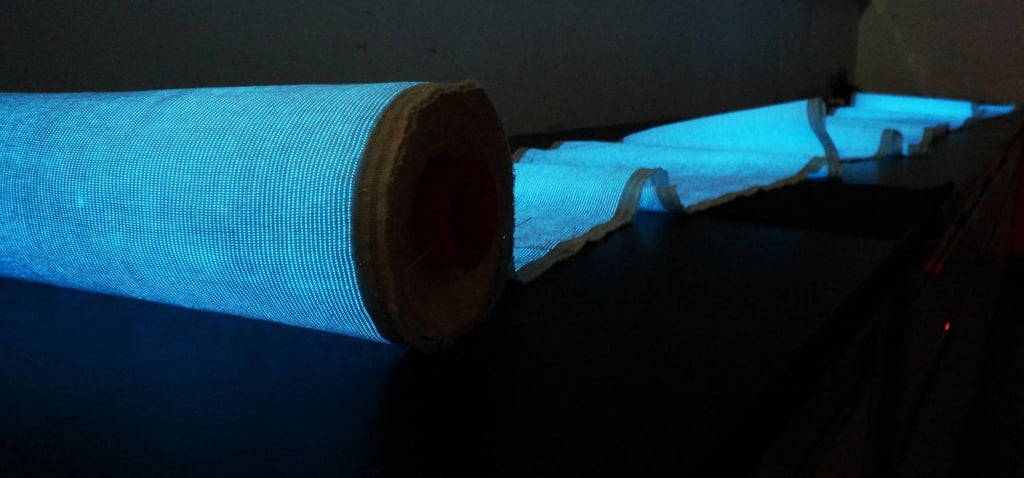
They are often made by attaching or weaving thin film light-emitting devices to fabrics, resulting in a material that is not breathable or very flexible. They are also often fragile and prone to damage, and in the past were only able to display predetermined patterns.
Peng and his colleagues have spent a decade thinking about ways to improve existing technology, experimenting with different materials. One option they formulated did not display well in the dark, while another fibre they came up with did not perform when it was woven.