Hiking round Mount Kailash in Tibet, world’s most sacred mountain, and how to train for it
Hong Kong-based pair talk about their high-altitude trek around revered mountain in Tibet, the pilgrims they passed, and how to prepare physically for the challenge

The journey begins with a bone-jarring four- or five-day road trip to the starting point in a remote, isolated and inhospitable corner of western Tibet. Then the 52km (32-mile) trek over a winding rocky trail commences at an altitude of 4,600 metres above sea level, which will eventually rise to 5,650 metres and average 5,000 metres over the whole journey.
Occasional snowfalls, strong winds and sub-zero temperatures accompany the low-oxygen rarefied air, and only the most basic amenities are available along the way.
The trek – called the Kora in Tibetan – is the circumambulation of one of the most revered mountains in the world, Mount Kailash. Thousands of people embark upon this test of mental and physical endurance every year and have been doing so since time immemorial.
At 6,638 metres high, Kailash is no match in height for Everest and other Himalayan giants. Its grandeur lies in its distinct pyramid-like shape, formed by the four sheer faces of its snow-capped summit that are perfectly aligned with the four points of the compass. Its mountain streams feed into the nearby sources of four great rivers: the Indus, the Brahmaputra, Sutlej and Karnali. At its foothill lies the pristine Manasarover, one of the highest freshwater lakes in the world.
Steeped in history and lore, Kailash is sacred to several religions. The Hindus believe it to be the abode of the god Shiva, known as “the destroyer and transformer” and the founder of yoga. The Jains believe that the founder of their faith, Rishabhdev, attained moksha, or salvation, at Kailash. Buddhists call it “Gangs Rinpoche”, meaning precious jewel of snow, and consider the mountain the home of the deity Demchog.
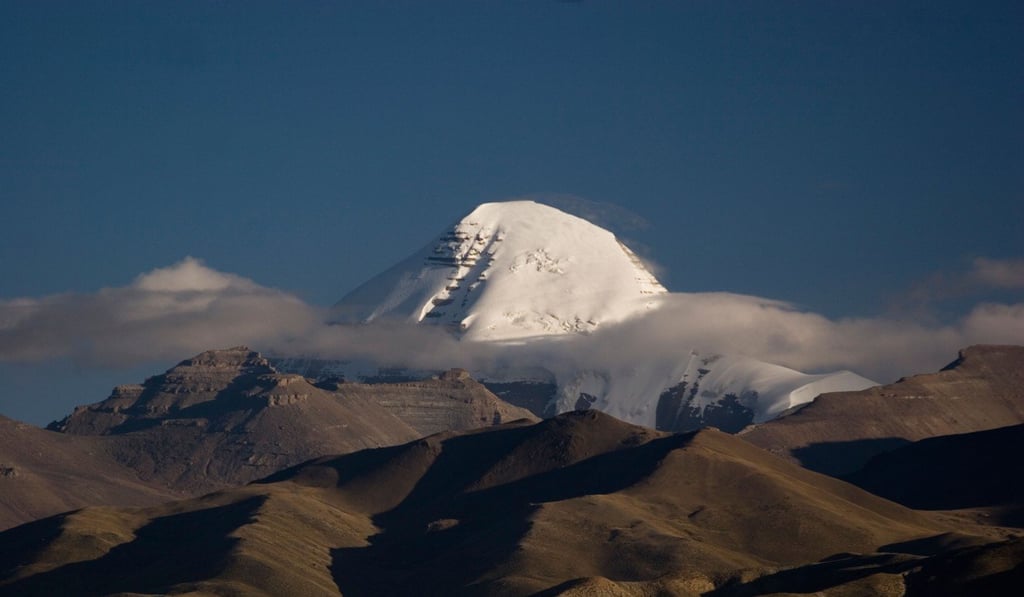
Kailash is venerated with such intensity that no one has scaled its summit to this day. To climb it would be to defile what is sacrosanct to millions. (Climbers unconcerned with religion will almost certainly not be given permits either, especially after the international backlash that accompanied reports of a Spanish team being given permission to climb it in 2001.)