Blind women trained to find breast cancer lumps by feel are better than doctors at the task
- They are called medical tactile examiners, or MTEs, and they work in India, Mexico, Colombia, and Austria, using their sense of touch to find breast nodules
- The women spend much longer than doctors on examinations, and can find smaller lumps; in India their detection rate is 100 per cent so far

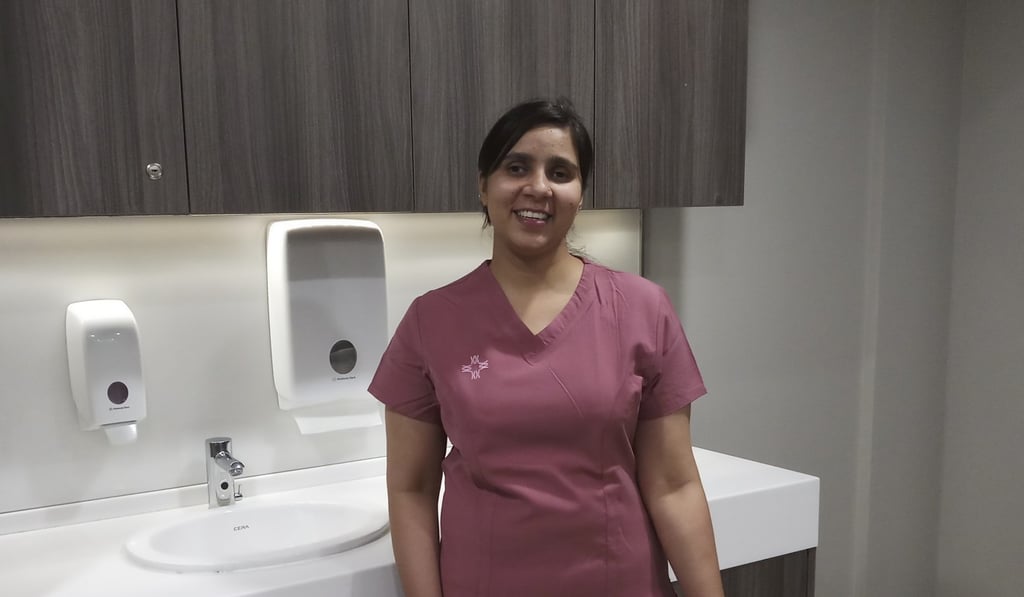
Dressed in a pink uniform, Hasiba Rani starts her first consultation of the day at CK Birla Hospital for Women in Gurgaon outside the Indian capital, New Delhi. After noting the patient’s medical history, she spends 30 minutes on a physical examination. Rani is “looking” for lumps or nodules in the patient’s breasts, only she cannot see. She is blind, and relies on her sense of touch.
Starting with the lymph nodes in the neck, she moves down to the collar bone, underarms, and every single centimetre of the breasts. She is guided by adhesive strips marked in Braille to ensure she leaves no part untouched and to help her report to the doctor, if she finds a lump, its exact location.
Rani, 25, has a serene demeanour, a soft voice, and a quiet confidence. She is one of seven blind Indian women who have been trained as medical tactile examiners, or MTEs, a role created for women who are blind and have extra sensitivity in their fingertips, either from having learned Braille or simply from having developed a greater sense of touch to cope with their loss of vision.
If women are physically examined by a doctor, palpation usually lasts a couple of minutes at most. Doctors are too busy. In a flash of insight in 2006, gynaecologist Dr Frank Hoffman, based in Duisburg, Germany, wondered if a blind woman could do a more thorough job than doctors of detecting small lumps – crucial to catching breast cancer early.