Traditional Japanese craftsmanship meets 21st century Singapore design in Hong Kong show
Year-long collaboration sees Singapore designers work with traditional Japanese craftsmen to help them innovate and reach out to new markets; the fruits of their partnership are seen in a display of beautiful, practical objects

The wind is howling and snow is piling up against the windows of Satoshi Hara’s workshop in Kashiwazaki, a coastal city in Japan’s Niigata prefecture. Plywood propped against the windows keep them from caving in under the weight of the snow.
“It isn’t even as bad as it was last week,” he says. “The snow was almost up to the roof. I’ve never seen it like this before.”
That’s saying a lot. Hara’s family has lived in the same compound for 400 years. This is where he was born and raised, and where he became a bronzesmith, following in the footsteps of his father, his grandfather and his great-grandfather before him – four generations that turned molten metal into delicate vases and intricate sculptures.
How Japan influenced Nordic aesthetics and vice versa, and why designs of both are growing more popular in Hong Kong
Dressed in loose jeans tucked into wellington boots, Hara crouches on the sandy floor of his workshop to build a makeshift oven from breeze blocks and charcoal. This is the final step in the process of making one of his bronze objects, burning the exterior to create a smoke-like pattern that he will tease out as he buffs and polishes the piece.
When he took over the family practice from his father, after completing sculpture studies at university, he eschewed traditional vases in favour of more organic forms. “I wanted to simplify the shape in order to highlight the pattern,” he says.
As he waits for the charcoal to heat up, Hara makes his way across a snowy courtyard to a small showroom. Next to vases, dishes, incense holders and figurines made by Hara and his father are a pair of unusual sculptures that look like spinning tops.
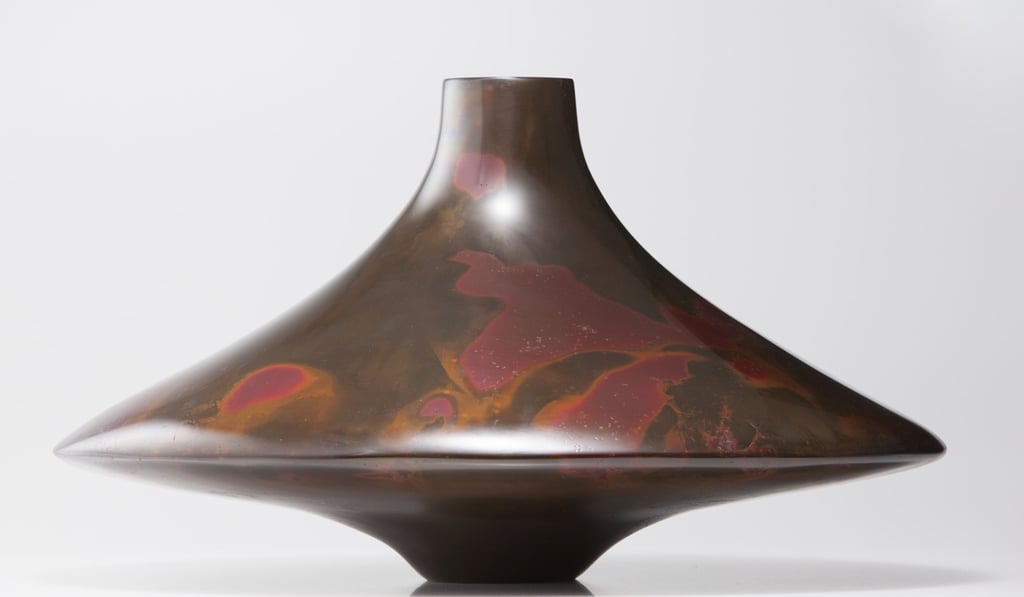
Their chestnut brown surface is splashed with patches of umber and red-violet from the burning and polishing process, which is called hanshidou. These are Dancing Flames, designed by Chris Lee of Asylum, a Singaporean design firm that has worked on hotels, restaurants and installations.