Jewel of ancient Roman Empire has lain neglected for years amid Libyan chaos and war, but there is hope for Leptis Magna after a year of peace
- Built by Phoenicians and conquered by Rome, Leptis Magna, on the Mediterranean coast, was home to emperor Septimius Severus
- He lavished wealth upon the city, which had a racecourse and a theatre, but tourism has been non-existent in Libya for decades

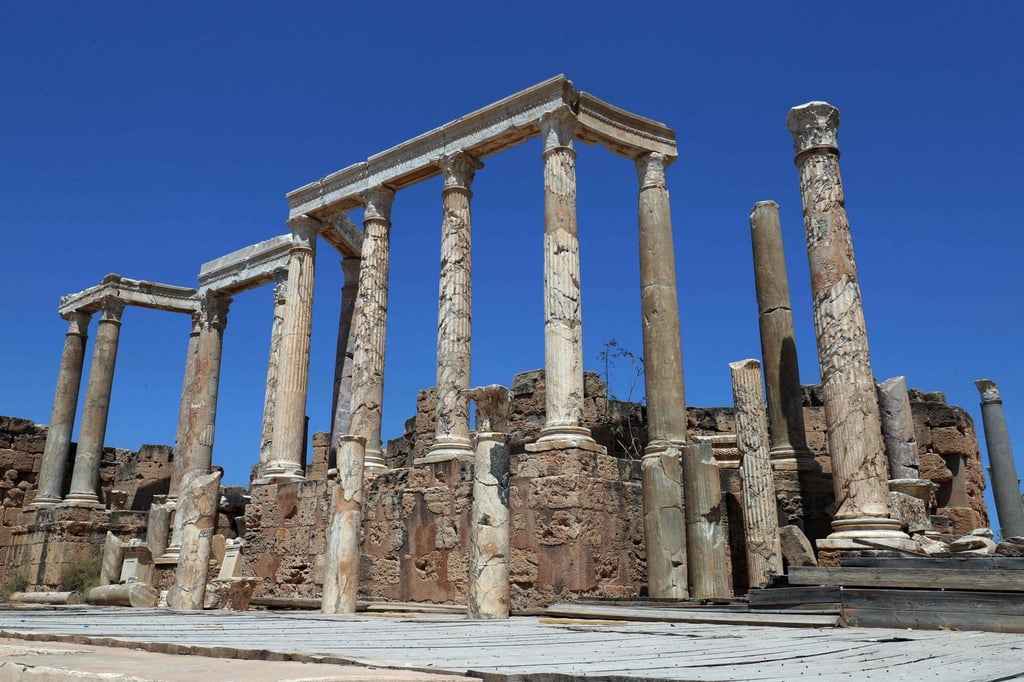
Among the Roman Empire’s most beautiful cities, Leptis Magna lies neglected and shunned by tourists after a decade of war, but some see its potential for rebirth.
There is no queue at the gate and only a handful of visitors, almost all Libyans, wander among the imposing ruins at the Unesco World Heritage Site. Visiting the area, a former Roman outpost on the south coast of the Mediterranean, is “a voyage in time, a dive into history”, enthuses Abdessalam Oueba, a Libyan visitor in his 60s.
Founded by the Phoenicians and later conquered by Rome, the city was the birthplace of Septimius Severus, who was emperor from AD193 until 211. The ruler waged military campaigns across Europe and into modern-day Iraq before dying in York, England, far from the hometown on which he had lavished resources.
Perched on a hillside with a striking view of the Mediterranean, the well-preserved ruins include a large basilica, a racecourse and a theatre that would have seated up to 15,000 spectators on arched terraces overlooking the sea.
Among the few visiting tourists are Ihab, from Tripoli, who made the 120km (75-mile) trip to show his children a site he had visited during his own childhood.