Is your sustainable hotel really ‘net zero’? Almost certainly not – most forget to mention embodied carbon
- Embodied carbon encapsulates all the harmful greenhouse gases emitted during the renovation and construction of a building, a huge part of any hotel’s footprint
- Few truly net-zero hotels exist; London’s Room2 Chiswick is arguably one, a prime example of sustainable transparency

Behold the American hotel of the future: it’s free of plastic bottles, anti-fossil fuel and powered entirely by renewable energy.
A renovation project, it gives new life to existing structures of concrete and steel, and reuses door frames, light fixtures and even tile. All of its guest rooms are decorated with locally made furnishings upholstered in sustainably sourced fabrics.
It’s rated LEED Platinum – one of just about a dozen hotels in the United States to claim the green certification programme’s highest rank. And it’s the first US hotel to receive Passive House designation, granted to buildings that meet stringent net-zero energy requirements.
When the Hotel Marcel opened in New Haven, in the state of Connecticut, in May, it checked all those boxes as part of a mission to be the first hotel in the US with net-zero carbon emissions. But for all of the ways in which the Marcel makes real efforts to be a green marvel, it missed one huge consideration: embodied carbon.
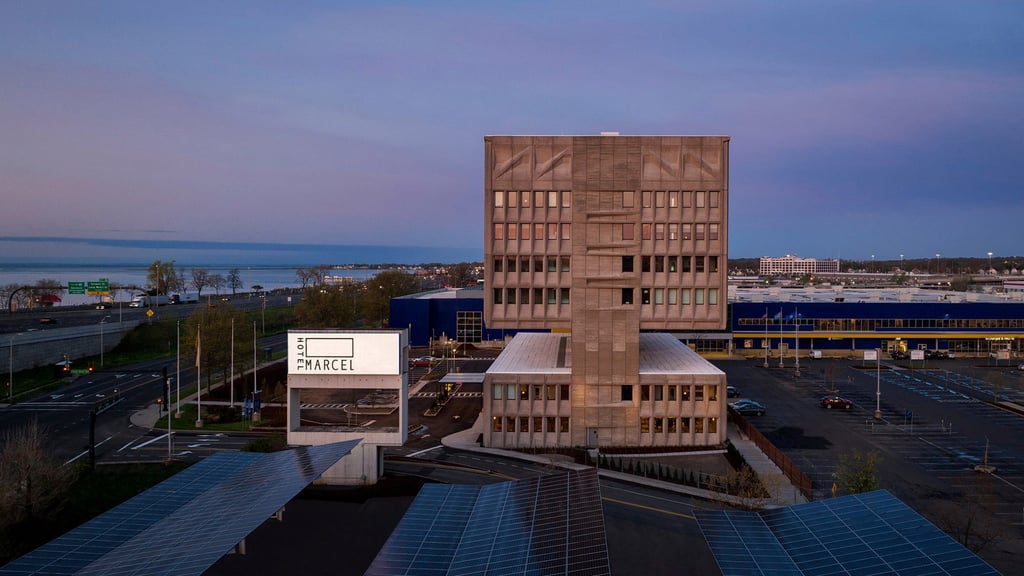
Embodied carbon is the term that encapsulates all the harmful greenhouse gases emitted during the renovation and construction of a building – an outsize part of any project’s footprint.
The Marcel’s triple-glazed windows? Good for keeping heating and cooling costs down, but a massive carbon emitter to manufacture. The hotel’s new, more efficient mechanical systems? They, too, emit large amounts of carbon during fabrication, transportation and installation.