The Darjeeling Limited
Local food and travel writer Nana Chan travels to India to sample some tea—after a spot of trekking, of course.
It is drizzling again this afternoon, at almost exactly the same time as it was yesterday—around 3pm. The air is filled with the smell of rain, musty yet refreshing, and tinged with a hint of smoke, possibly from burning pine wood. Along the way, a handful of Nepali homes stand sparingly in the mountainous terrain. An occasional rooster, all shiny-feathered and exuberant, starts calling out of nowhere, and children whiz by, down a muddy slope, chasing one another on rickety skateboards.
We are now 3,600 meters above sea level and have been walking an average of seven hours per day for three days already. I have never walked for more than two days in my life, let alone gone without showering for more than three. I am tired and hungry, and the sole traveler all the way up here at Phalut, in the lone trekker’s lodge. Dinner tonight is once again a potato stir-fry and rice, cooked over firewood in a non-ventilated room. It’s 0C here, and with the smoke burning my eyes and my mouth firing from the world’s hottest chili, I feel dizzy and nauseous.
“Don’t worry,” my guide Sanu says, handing me a glass of water, as he promises that all this effort will be worth it tomorrow when I see the sunrise, or he will guide me for free. I am ready to take him up on his offer, and I seem to feel better already. I gulp my water, quickly finish my dinner and go to bed. It is only 8pm.
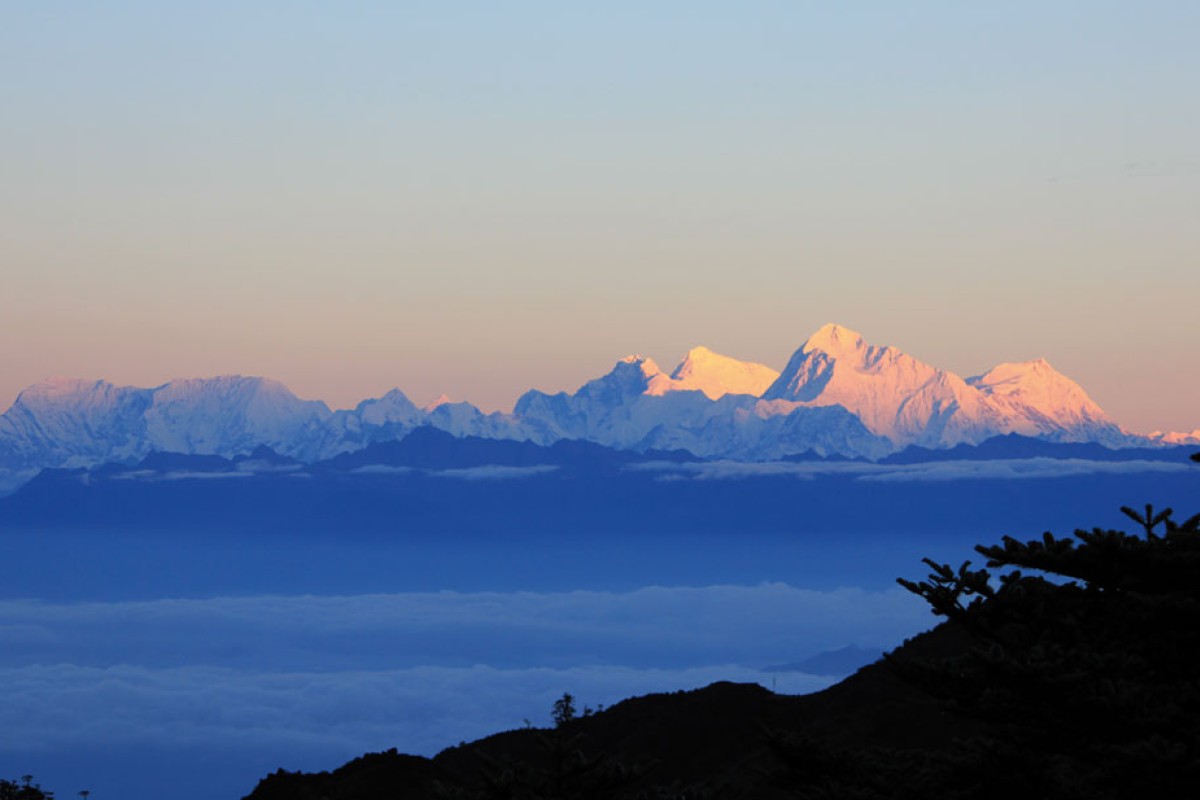
There are no adequate words to describe what I see the next morning. We get up at 5am and start hiking up to the viewpoint. A trickle of sunlight wades weakly through a thick blanket of morning mist. I turn around, and find a flicker of yellow resting upon the bright red roof of my lodge. Beyond, a stream of clouds is dispersing slowly, like waves in slow motion. The grass beneath my feet is soft and golden, and when we finally reach the top, I am awestruck. Right in front of us, from a distance that seems like only a few meters, lies the mighty Kanchenjunga range, snow-capped and immaculate. I feel like I am in the presence of something bigger than and beyond me. It is funny how fragile one becomes in the face of beauty, and I turn to Sanu: “Don’t worry, you’re still being paid.”
This is the highlight of my Kanchenjunga trek, an 88-kilometer course sandwiched between Nepal and the Sikkim and Darjeeling areas of India. From Phalut, we descend 15 kilometers slowly down to Gorkhey, a small village nestled in an idyllic river valley and surrounded by cornfields. On the creek bank, wood-beamed chalets glisten in the afternoon sun, while pots of rhododendrons sit neatly arranged on their front porches. I try my hand at grass-cutting and corn-shelling, to the amusement of the locals, and for a moment, find myself utterly disoriented. If not for the prayer flags fluttering in the wind and the occasional bouts of Nepali emanating from gossiping village girls, one could easily have mistaken Gorkhey for Switzerland. Yet we are not even in Nepal but on the northern tip of West Bengal in India, an area dominated by the Gurkhas, a people originally from Nepal and known for their bravery and strength in the British army’s Brigade of Gurkhas.
On my last day, we depart from Rimbik and move on to Darjeeling, a hill station perched more than 2,000 meters above sea level and internationally renowned for its tea industry and the “toy train,” a World Heritage Site built in the late 1800s by the British and still powered today by a steam locomotive. Everywhere you look you see remnants of its colonial past; schoolchildren dressed in preppy uniforms, rundown Victorian houses crammed up on steep slopes in a most precarious fashion—and the tea gardens, acre upon acre of tea gardens.