Is the West Kowloon Cultural District finally taking shape?
Since the idea was first proposed two decades ago, the West Kowloon Cultural District has been plagued by delays and controversy. But a visit to the site by Post Magazine shows that it may all be slowly coming together

Hong Kong is not alone in having witnessed the long and painful gestation of a much-vaunted cultural monument. In 1958, Chinese premier Zhou Enlai had a grand vision: a new opera house on the west side of Beijing’s Tiananmen Square – which wouldn’t be built until nearly half a century later, when the National Centre for the Performing Arts finally opened. And last month, Hamburg’s Elbphilharmonie held its first concert seven years late; 10 times over budget the Herzog & de Meuron concert hall had come under the scrutiny of a German parliamentary inquiry for, among other things, its extremely expensive toilet brushes.
Still, local taxpayers and art communities would never have guessed that, nearly two decades after then-chief executive Tung Chee-hwa proposed the West Kowloon Cultural District (WKCD), the 40-hectare site would remain largely unbuilt, be with no estimate of a final cost and mired in fresh controversy.
In 1998, we were promised the cluster of harbourfront visual and performing arts facilities would transform Hong Kong into “Asia’s arts and cultural capital” and that the first batch of theatres would have opened seven years ago. The secret plan for a branch of Beijing’s Palace Museum on the site and the public indignation that followedare just the latest problems for a project that has been plagued by construction delays, botched design plans and a revolving door of senior executives.
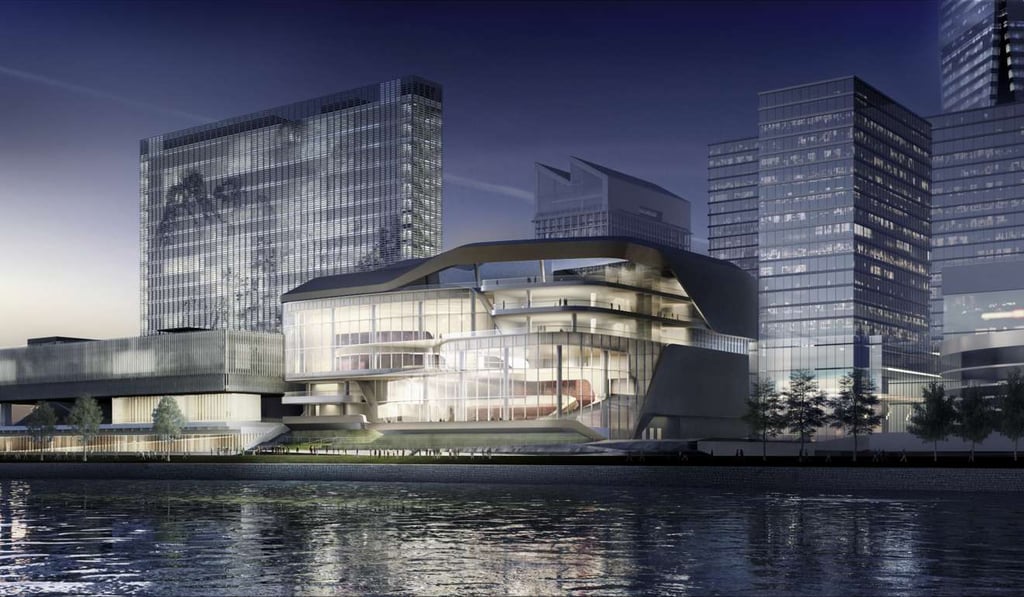
Yet, the future of WKCD is more secure now than at any time since Tung stepped down, in 2005. On January 18, just three weeks after Hong Kong learned of the HK$3.5 billion Palace Museum plan (separately funded by the Hong Kong Jockey Club), Chief Executive Leung Chun-ying announced in his final policy address that the development rights pertaining to the commercial property portion of the cultural district would be transferred to the WKCD Authority (WKCDA), meaning revenue from a hotel, offices and residential buildings will go towards funding the cultural facilities rather than into government coffers. A total gross floor area of up to 366,620 square metres – slightly more than the 308,940 square metres first proposed, in 2007, and accounting for about 43 per cent of the site – can now be used for commercial development. The rest of the land will be dedicated to arts and cultural/communal facilities (41 per cent) and retail, dining and other nightlife (16 per cent).