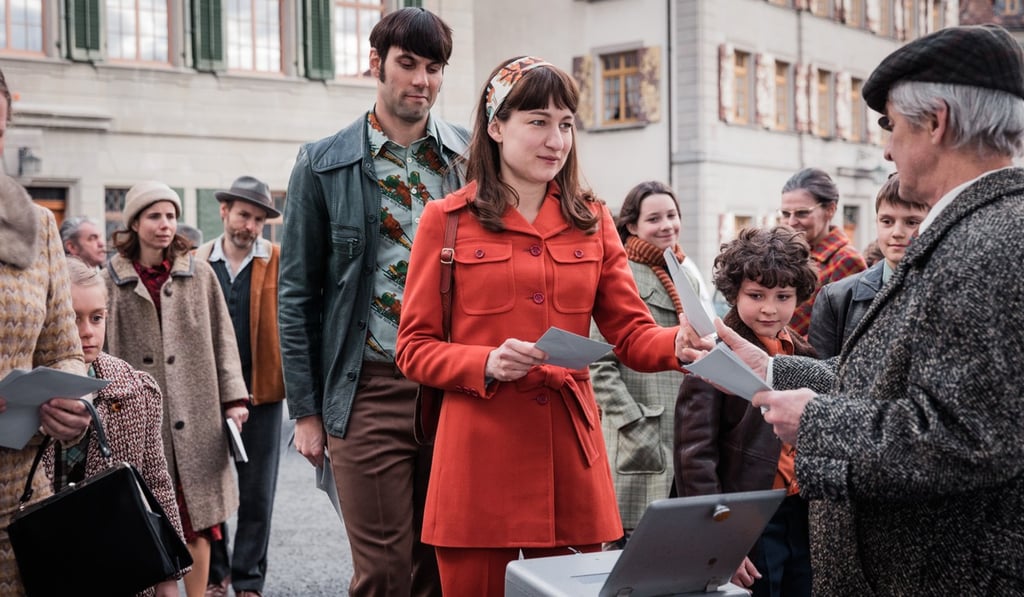
Art house: suffrage film Divine Order recalls Swiss women’s fight for the right to vote
Directed by Petra Volpe, the movie melds intimate drama, politics and history as it illustrates how Switzerland’s suffragettes fought long and hard before they were eventually granted the right to vote in 1971

Switzerland did not give women the vote until 1971, much later than other European countries. Even then, it was a tough battle, as women had to convince men to vote “yes” in a referendum in which females were barred from taking part. Petra Volpe’s The Divine Order (2017) manages to tell the story of the vote in a personal manner, without skimping on the politics, and that’s something of an achievement.
The film melds intimate drama, politics and history into a homogenous whole that illustrates the feminist rallying cry, quoted in the film, that “the personal is political”. The result is a satisfying movie that packs hefty emotional and philosophical punches.
Nora Ruchstuhl (Marie Leuenberger) lives with her husband, Hans (Max Simonischek), and her two sons in a small Swiss village. Conflict arises when Nora tells Hans she wants to return to work, and he forbids her – under Swiss law, a woman needed her husband’s permission to take a job. Nora quickly becomes attuned to the sexism and gender discrimination that exists in the village, and is politicised by an encounter with a feminist group in a nearby city.
The group introduce her to the literature of writers such as Betty Friedan, and teach her about personal empowerment and the sexual revolution. With the help of a few friends, Nora tries to mobilise women in the village to agitate for emancipation in an upcoming referendum on the issue. But all the men, her husband included – and even some of the women – are hostile to her efforts.