The CollectorSearch for missing Qing-dynasty ritual vessel takes novel approach – 3D-printed replicas
Of the eight kinds of Qing-dynasty ritual vessels, one continues to elude collectors but a Sydney-based retired engineer is determined to track it down

Dedicated collectors can become preoccupied with filling the gaps in their collections. For Sydney-based retired engineer Iain Clark, the gap that niggles isn’t just what’s missing in his personal collection. It is one of eight types of Qing-dynasty ritual vessel that, as far as experts are aware, nobody can recall ever having seen.
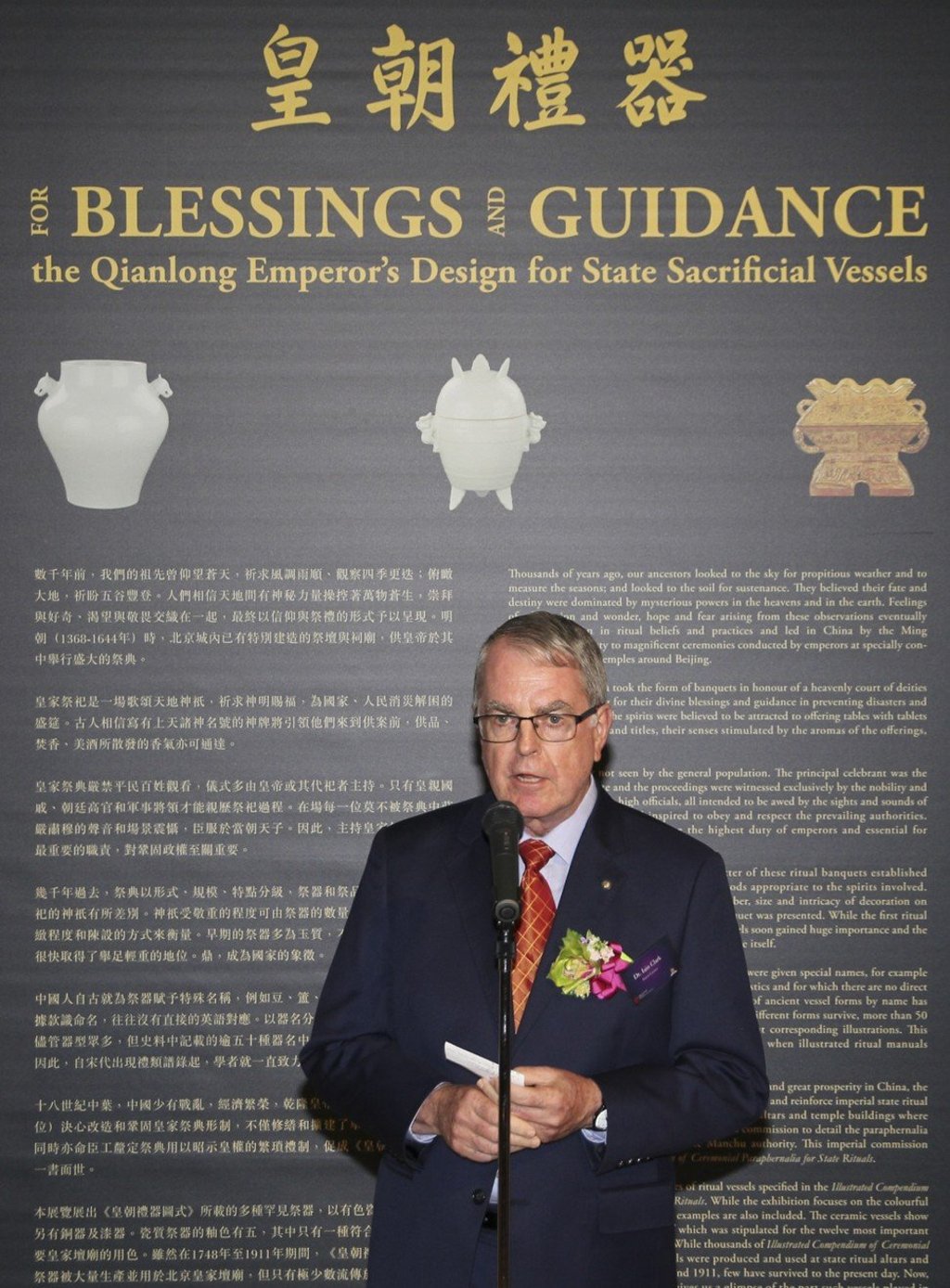
Clark was in Hong Kong last month for the opening of “For Blessings and Guidance”, an exhibition of sacrificial vessels designed by the Qianlong Emperor (1711-99) for use during rituals that reinforced the sovereign’s claim to a mandate from heaven. Of the 60-odd pieces on show at the Art Museum of the Chinese University of Hong Kong, in Sha Tin, 15 were donated by Clark. Most of the others were either donated by or are on loan from local developer Anthony Cheung Kee-wee. It is a rare chance to see so many of these 18th-century, distinctively shaped pieces in one place. Only Beijing’s Palace Museum has more such late-Qing vessels.
Mention Chinese ritual vessels and many collectors would think of bronzes dating back to the mystical Shang and Zhou dynasties (circa 1600BC-771BC). So did Qianlong. He thought that since his predecessors had presented gifts to the gods in vessels named after the ancient bronzes – Qing rulers had a penchant for integrating Han traditions with their own Manchurian practices – the objects ought to resemble the Shang and Zhou originals, for the sake of historical continuity.
He also sought to codify centuries-old customs by supervising the compilation of the Illustrated Compendium of Ceremonial Paraphernalia for State Rituals, which took 19 years to complete and featured more than 1,000 pictures of rituals, dresses, jewellery, insignia and weapons, and specifications for eight standardised, mostly porcelain vessels, including specific tureens for cereals and meat and vegetable dishes.
According to the rules, each of 12 dedicated sacrificial altars in Beijing was assigned one of five colours and in most only vessels of that hue could be used: for instance, blue for the Temple of Heaven; yellow for the Temple of Earth; white for the Temple to Taisui (or Hall of Jupiter and God of the Year); and red for the Temple of the Sun. Bronze vessels were used for the Imperial Ancestral and Confucius temples. The former, unusually, had multicoloured vessels. There were gilt lacquer ones, too. It was a capital offence to use these containers for any other purpose.
The exhibition also includes a blue dragon gown that Qianlong probably wore for the autumn ritual at the Altar of Heaven and which Chung bought in a London auction last year.