The CollectorMacau’s casinos are betting big on art - but why?
- Art Macao, a partnership between the government and casinos, is bringing major artworks from all over the world to the city but what would the masters think about the choice of ‘gallery’?
- With their licences up for renewal in 2022, the resorts are trying to deflect attention from their unseemly core business to show they are benefiting society

The proliferation of casinos in Macau since 2003 has been a spectacle to behold. Last year, these establishments helped bring nearly 36 million tourists to the city (population 650,000), proving there is a big market in Asia for Las Vegas-style kitsch.
In an effort to be family-friendly, these so-called integrated resorts have hotels, shopping malls and theatres hosting shows such as the long-running House of Dancing Waterat City of Dreams. And now the inaugural edition of Art Macao will ascertain whether casinos can bring art to the masses. But with such an unsavoury business at its core, can a partnership between casinos and government to promote the arts succeed?
Last Sunday, Macau’s secretary for social affairs and culture, Alexis Tam Chon Weng, launched the four-month-long festival, which kicked off with a series of art exhibitions. The casinos’ role is twofold. All six gaming-licence holders in Macau (together with state-owned conglomerate Nam Kwong) are helping to pay for the festival, which includes public art installations at historic sites such as the Ruins of St Paul’s, two free touring exhibitions at the Macau Museum of Art (MAM), a National Art Museum of China showcase of works by modern Chinese masters and a British Museum exhibition of Italian Renaissance drawings by the likes of Michelangelo and Leonardo da Vinci. The casinos are holding their own exhibitions – featuring art from their collections or works commissioned for the festival – in the public, non-gaming areas of the resorts.
As part of Art Macao, Sociedade de Jogos de Macau (SJM), the oldest gambling operator in the city, of which Sabrina’s mother, Angela Leong On-kei, is co-chair, will be rolling out exhibitions on the theme of “cultural heritage” at a number of its properties. The artworks, either owned by SJM or on loan via Poly Auction, include Wu Guanzhong’s Coastal City (Qingdao) (1975) and Twin Swallows (1988); the latter was sold by Poly Auction in December for 54 million yuan (HK$61 million). Paul Gauguin’s Coin du Jardin (1885), which Poly Auction sold for HK$41.3 million at SJM’s Grand Lisboa hotel in November, will also be shown. SJM has declined to identify the new owners of the two recently-sold works.
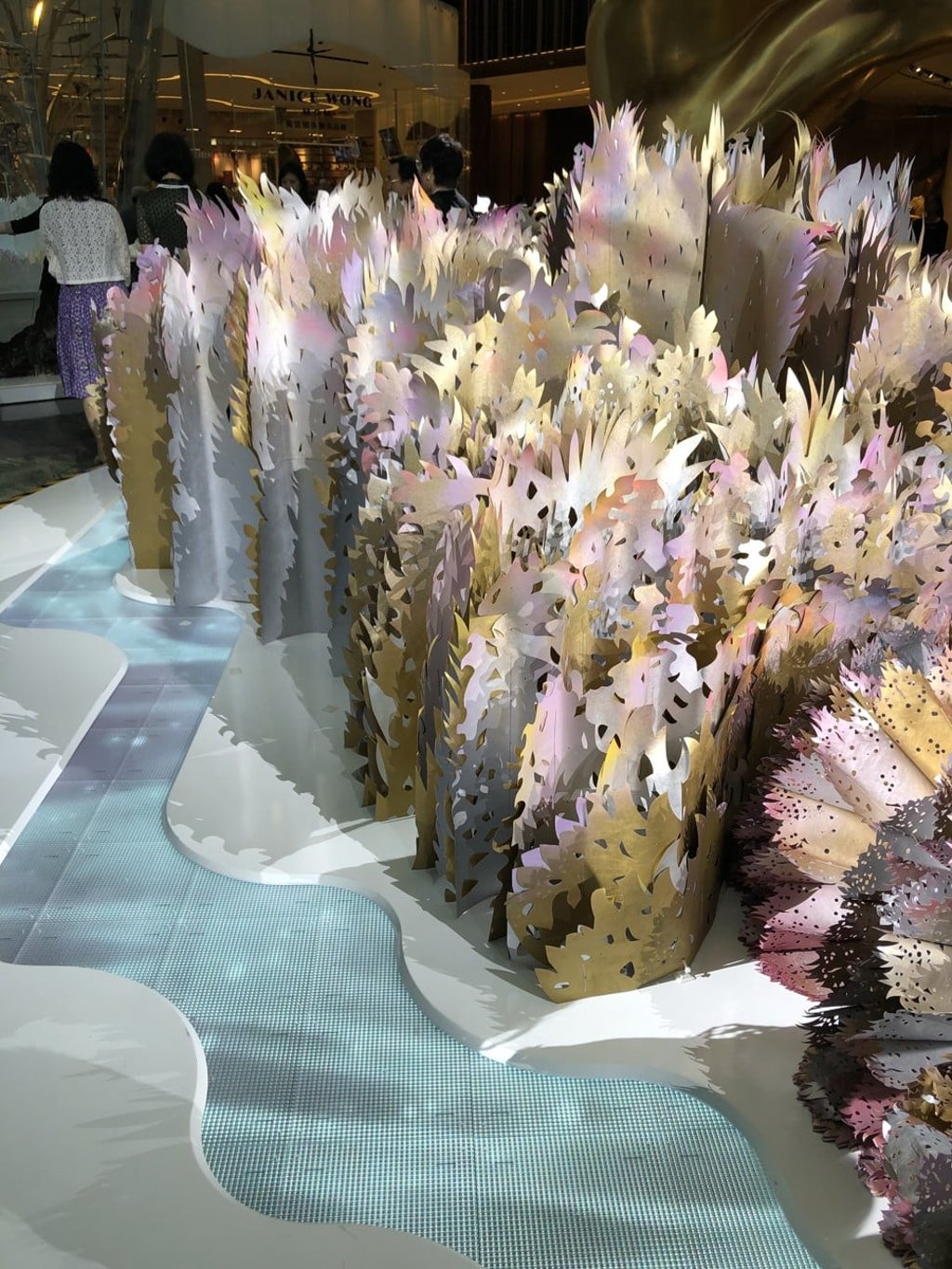
Pansy’s MGM Cotai is going for size over quantity. Two works, both contemporary takes on traditional Chinese ink art, have been commissioned with help from Shanghai’s Museum of Contemporary Art. Jennifer Wen Ma, a visual artist who splits her time between New York and Beijing, has created a paper sculpture garden called A Metamorphosis: No End to End (2019), which fills about a third of the hotel’s glass-covered atrium. (Called “Spectacle”, the atrium is so large its glass roof holds the Guinness World Record for biggest of its kind.)
The other piece is Yang Yongliang’s Journey to the Dark II (2019), a new version of his immersive video that shows China’s contemporary cityscape in the tradition of Song-dynasty ink scrolls. The work, which is being screened at MGM Cotai’s theatre, combines familiar night scenes in Hong Kong and Macau with a haunting, urban soundtrack.