Designing Hong Kong’s Xiqu Centre, performing arts venue and gateway to West Kowloon Cultural District
Following the death of Bing Thom, the architect behind Tsim Sha Tsui’s Xiqu Centre, Venelin Kokalov, of Revery Architecture (formerly Bing Thom Architects), finished the project in collaboration with Ronald Lu & Partners

Interpretation
“We won the project via an international design competition in 2013. Our vision was to give something to Hong Kong that would help to bring local cultural heritage to a new generation. As a gateway for the West Kowloon Cultural District, we wanted to create an art form using different construction techniques.
“A key design element was raising the main theatre about 27 metres. So instead of a massive, unfriendly building at ground level that is only used for two hours in the evenings, we created an urban plaza beneath the theatre that can be used for exhibitions, performances and as a meeting point, inviting the public to linger and explore.”
Challenges
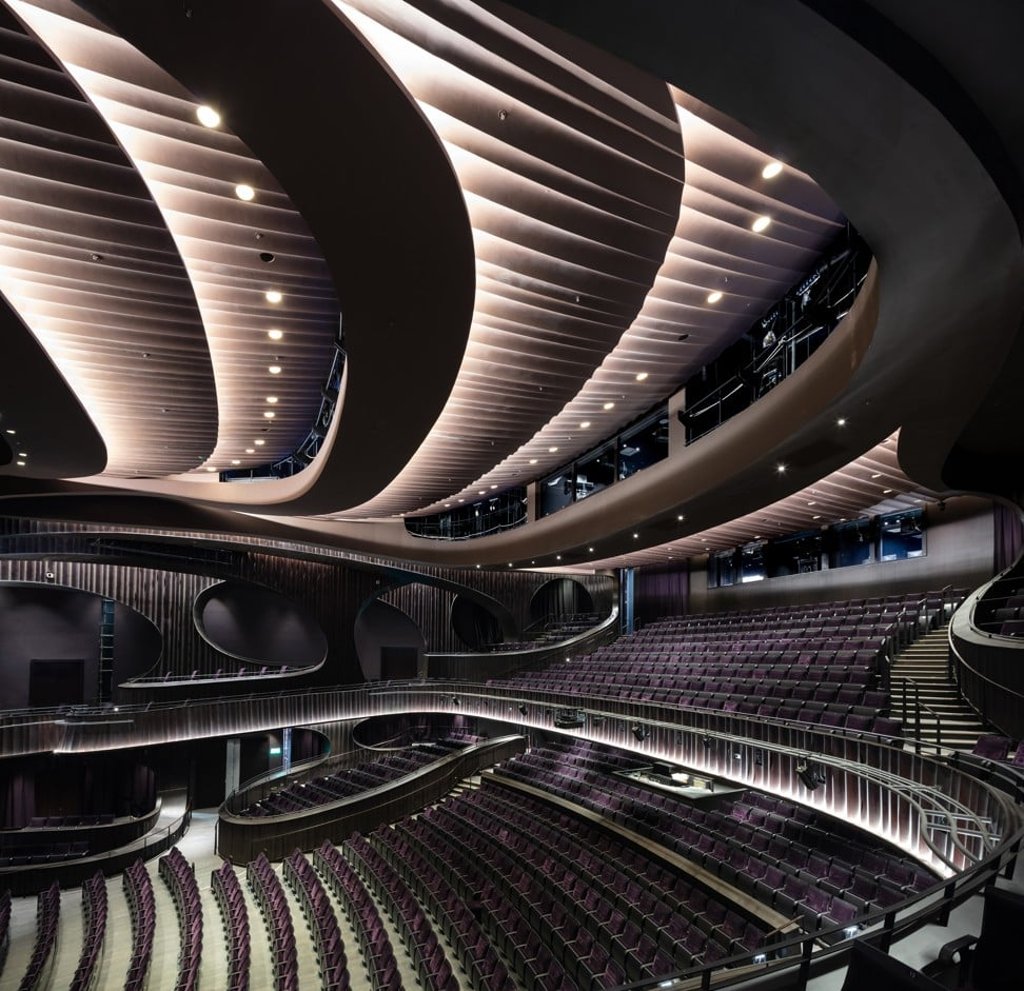
“The size of the site was tiny compared with the scale of the building and the requirements of this type of performance. Traditional Chinese opera [xiqu] is a storytelling art form – it is important to bring the audience close to the stage, so they can see the performers’ gestures and details of the costumes. So, Xiqu Centre is a 1,073-seat theatre that feels intimate. At the same time, a lot of back-of-stage area is required. You also have to get the acoustics right. [London-based firm] Sound Space Vision integrated audio systems and acoustics allowing for a wide and continuous spectrum of acoustical production, from highly amplified to natural.”
Highlight
“The facade. It creates magic by appearing like a stage curtain that moves mysteriously as you walk through, its colours changing with the natural light. We achieved this by using a modular system of scaled fins cut from untreated marine-grade aluminium pipes, arranged in alternating patterns along the building. It is intended to create a transition from the busy streets outside, giving people time to adjust and focus as they arrive.”